Published: September 10, 2026
Last Updated: September 10, 2026
People define generative AI a few different ways. At its core it’s a model that makes new stuff. Text, images, code. Not just sorting or scoring things that already exist. ChatGPT counts. So does Midjourney. So does GitHub Copilot. Used any of those? Then you’ve used generative AI. What follows: how it’s trained. What it can turn out. How it’s different from older algorithms. Where it still falls short.
Quick Answer: Text, images, code, audio, generative AI turns learned patterns into new content like this. Conventional AI doesn’t do that. It just classifies or predicts.
Definition: Generative AI is a group of artificial intelligence systems trained on existing data. The patterns are in there, buried in the data. It picks them up. Then it puts them to work: new text, new images, new code, new sounds.
What Is Generative AI and How Does It Work?
Generative AI works off statistics baked into the training data. It builds a model from those statistics, and from there it’s just predicting: what’s the most probable next token, next pixel, next sample. Prediction from a learned distribution is what makes it different from say an ai written to classify or rank.
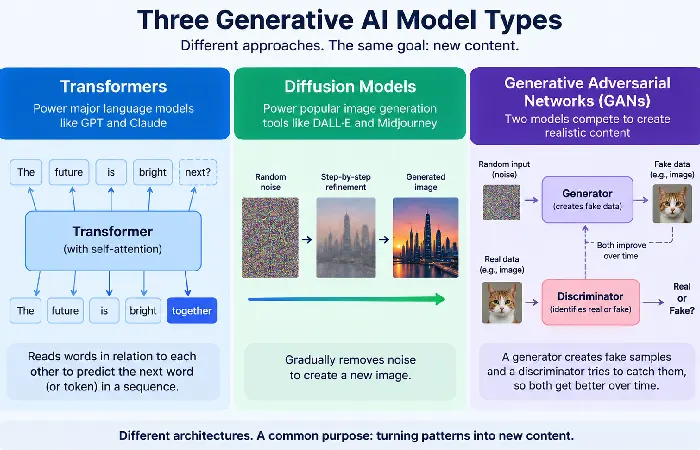
Three model families do most of the work:
- Transformers, which run major language models (think GPT or Claude), read words in relation to each other to determine what word to write next,
- Diffusion models, another of the popular image tools, work on the premise of taking random noise and gradually refining it into an image through iterations.
- Generative Adversarial Network, or GAN for short, is a pair of neural nets competing against each other. One generates fake samples and the other attempts to identify, or indeed catch, the fakes until the forger proves convincing.
Generative AI models find patterns and make connections in the data. Then it applies that to a prompt. The result: content that wasn’t there before the request was made. Usually that’s a text prompt. But it can just as easily start from an image, an audio file, or a block of code.
How Are Generative AI Models Trained?
Generative AI works by building a model on the statistics in the training data. From there it predicts the most probable next piece of content, one token, one pixel, one sample at a time. Prediction from a learned distribution is what makes it different from say an AI written to classify or rank.
Pre-training is done initially. A model is trained on a large, generally unsupervised corpus, for a language model this means books, articles, and websites. It learns the general patterns of grammar, structure, and meaning along the way. This is the “foundation model”: a large general-purpose model trained once then can be adapted (see below) for many applications.
Fine-tuning comes second, and it’s what turns a general model into a useful one for a specific job:
- Now, begin with a pre-trained foundation model.
- Continue training it on a much narrower corpus: healthcare records for a clinical assistant, legal contracts for a contract-review tool, whatever fits the job.
- Fit the model outputs to the style, standards of accuracy, and vocabularies of the domain.
The quality of the training data is more important than the size of the model in most real world failures. A model that has been fine tuned on stale or limited data will confidently give answers that are stale or limited. This is the cause of most of the hallucination complaints raised later in this piece.
What Can Generative AI Create?
Text, images, audio, video, code, synthetic data, generative AI can produce all of it. What you actually get back depends on which model architecture is doing the generating. Five categories cover nearly all real-world use:
- Text: essays, code, translations, and conversational responses from large language models
- Visual: images, 3D models, and video generated by diffusion models, used for everything from product mockups to game assets
- Audio: music composition and sound effects generated by models trained on existing audio tracks
- Code: functional code suggestions from tools like GitHub Copilot, which speed up development by generating snippets a developer then reviews
- Synthetic data: the creation of artificial data which is used to train a second AI model when the original data set is inadequate, sparse or does not include enough edge cases.
The use case for software development is one of the fastest progressing. Developers rely on generative AI for code suggestions. It catches more bugs during testing. It cuts down on repetitive tasks. Development moves faster, but human review never leaves the process.
Generative AI vs Traditional AI: What’s the Difference?
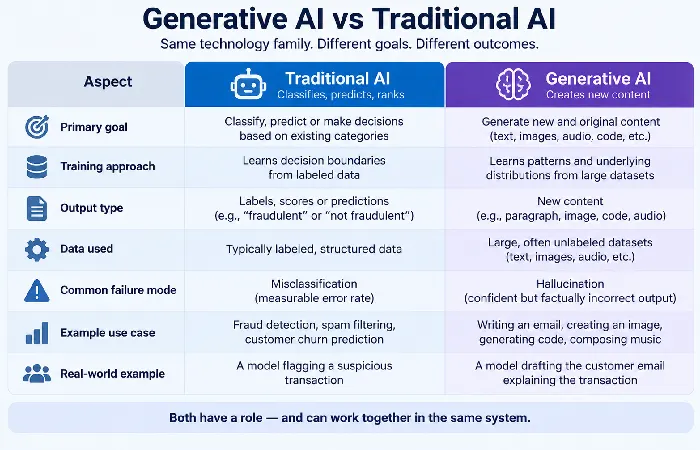
The fundamental distinction comes down to what each system was trained to do. Traditional AI classifies input into labels it already knows. Generative AI generates output that wasn’t there before the prompt. The implications are:
- Start with what each one does. Traditional AI classifies. It ranks. It predicts. Always against categories it already knows going in, nothing new there. Generative AI is the opposite story. Text, images, audio, code, none of it existed until the prompt called it into being.
- The learning process is different too. One learns a decision boundary between known classes. The other learns the underlying probability distribution sitting inside its training data.
- That difference shows up in the output too. A label. A score. A prediction like “fraudulent” or “not fraudulent.” That’s what Traditional AI hands back. Generative AI hands back an artifact instead, a paragraph, an image, a block of code.
- The failure modes split apart just as much. Traditional AI’s problem is misclassification, and you can measure it as an error rate. Generative AI fails differently: hallucination. Confident. Fluent. And factually wrong.
- Picture it in production. A fraud-detection model flagging a suspicious transaction, that’s traditional AI at work. The model drafting the customer email explaining why the transaction got flagged, that’s generative AI.
Each can exist simultaneously in a single enterprise. A side-by-side breakdown of AI types covers where each category fits beyond just this generative and traditional division.
Benefits, Limitations and Risks of Generative AI
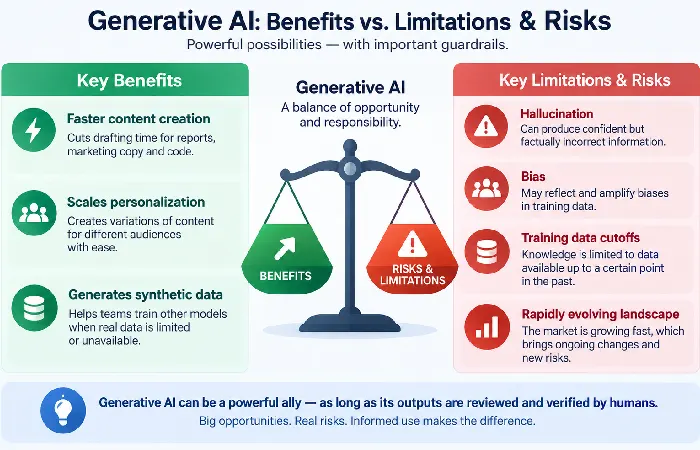
The single advantage of Generative AI is that it can rapidly produce usable first-draft content faster than any human team. The one risk it has is that it can produce that content at 100% certainty even when it’s in fact incorrect. Both are equally important when considering how much to trust its outputs.
Benefits worth acting on:
- Cuts drafting time for reports, marketing copy, and code by providing a starting point instead of a blank page
- Scales personalization, creating variations of the same content adapted to each audience without rewriting from scratch each time
- Facilitates the creation of synthetic data for teams and projects that lack sufficient real data to help train other models
Limitations and risks worth planning around:
- Hallucination: the model guesses the next likely word or pixel rather than the real one, so the longer the output runs the more likely it will drift away from the truth.
- Bias: generative AI poses very real dangers of abuse and inaccuracies, and legal systems in the majority of countries haven’t yet adapted to the capabilities of the technology
- Training data cutoffs: most models have knowledge only of what was present in their training data up to some point in the past, so their information about recent events, current pricing, etc needs verifying elsewhere
- Market size, as background: estimates already put the generative AI market at roughly $91.57 billion for 2026, expanding at a 34.3 per cent compound annual rate through 2031 (as per Jotform, citing market research), which is a benchmark for understanding how rapidly tooling and best practices are moving under you
However, that doesn’t imply that generative AI can’t be trusted for all jobs. The results need a human check first. Before they reach a consumer, a patient, or a legal filing, especially the longer and more open-ended the request.
FAQ’s
1. What is generative AI in simple terms?
Generative AI is a type of artificial intelligence, sure, but the mechanics are different from what most people picture in their head. Older systems categorize, extract, or score content that’s already there. This doesn’t do that. It produces something new instead, text, imagery, audio, whatever the model is built for. It is trained on a set of data to learn a range of patterns, then provided with a prompt to generate something novel.
2. Is generative AI the same as machine learning?
No. Machine learning is the bigger area of systems that learn on data and generative AI is one application of it. A model for fraud detection is machine learning and a model for generating the follow-up email about that fraud warning is generative AI.
3. Why does generative AI sometimes make things up?
This is ultimately because it predicts the next most statistically likely word/pixel as opposed to checking facts. This is why when a fact was not evident in the training data the model still gives the response confidently but in a fluent manner. That’s why hallucinations read as plausible instead of obviously wrong.
4. What are examples of generative AI in use today?
ChatGPT and Claude for text. Midjourney and DALL·E cover images. GitHub Copilot handles code, and it’s become the default for a lot of developers doing day-to-day work. Those three, across writing, design, and software development, are what people actually reach for.