Published: September 4, 2026
Last Updated: October 1, 2026
IT security automation takes time-consuming manual security tasks and substitutes software that detects, investigates, and sometimes resolves threats, without human intervention on each individual alert. Not many enterprises automate everything immediately usually they focus on the most common and easily replicable security practices first.
- What it solves: Alert fatigue arising from the thousands of daily SIEM alerts
- Starting where they begin: Phishing triage, vulnerability scanning, log correlation.
- Where humans remain engaged: Attribution of novel threats, decisions requiring high-consequence remediation
Next the page explains what security automation is in reality, which tasks can be automated presently, how automated detection and response works and the existing risk.
Quick Answer: Automated security has the speed advantage over human SOC teams by automating the process of detection, containment and remediation of threats of security through use of AI and the use of playbooks.
Definition: IT security automation is the application of software, artificial intelligence, and predefined playbooks for detecting, analyzing, and responding to cyber security incidents without requiring a human to complete every step manually.
Automation adoption snapshot (2024 survey data)
| Metric |
Figure |
Source |
| Orgs using automated response tools |
64% |
SANS 2024 Detection & Response Survey |
| Orgs with fully automated response |
16% |
SANS 2024 Detection & Response Survey |
| Plan to expand AI/ML in detection |
67% |
SANS 2024 Detection & Response Survey |
| Most-automated task: phishing response |
52% |
SANS State of Automation Survey |
| Breach cost, extensive AI/automation use |
$3.84M |
IBM Cost of a Data Breach Report 2024 |
| Breach cost, no AI/automation use |
$5.72M |
IBM Cost of a Data Breach Report 2024 |
Methodology: Figures pulled directly from named vendor and research surveys; all data is publicly available information.
What is security automation?
Security automation is software-driven execution of security tasks that would otherwise require a human analyst to complete manually, step by step. It doesn’t mean removing people from security operations — it means removing people from the repetitive parts of the process.
The majority of present deployments are in the middle zone instead of full autonomy. Based on the SANS 2024 Detection & Response Survey, 64% of organizations employ automated response tools but only 16% of them implement cyber response processes in automation mode. That discrepancy is significant: it indicates that the most prevalent real-world model is automation of refined, familiar procedures, rather than automation of the entire security infrastructure.
In a security automation deployment there are two parts that usually play off each other. One of them is the SIEM (Security Information and Event Management), and its job is to collate and cross-reference log data, pulling everything into one place so the patterns show up. From there, SOAR (Security Orchestration, Automation, and Response) takes over, running the appropriate playbooks on every alert the SIEM flags.
Security tasks that can be automated
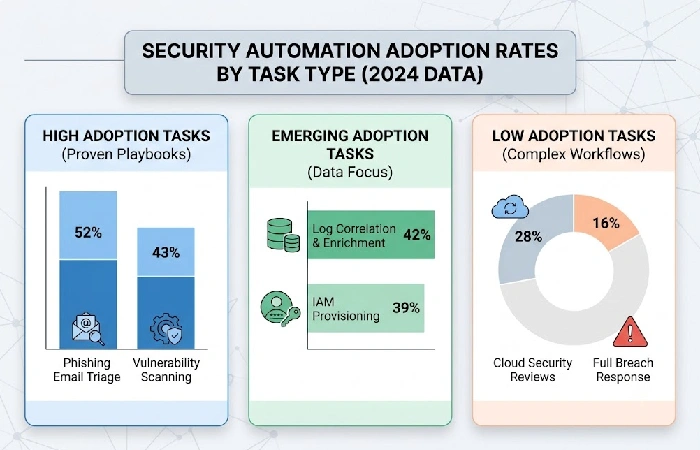
The tasks organizations automate first are the highest-volume, most repeatable ones — not the most complex ones. Phishing response leads adoption, followed by vulnerability management and data enrichment.
According to the SANS State of Automation in Security Operations Survey, phishing response is the most commonly automated security process, cited by 52% of respondents, and vulnerability management is automated by 43% of respondents while data enrichment is automated by 42%.
Currently high-automation tasks:
- Phishing email triage and quarantine (52% adoption)
- Vulnerability scanning and prioritization (43% adoption)
- Log correlation and data enrichment (42% adoption)
- Routine patch deployment
- IAM provisioning/deprovisioning based on role changes
Still largely manual:
- Cloud security configuration reviews
- Full end-to-end breach response
More complex functions such as breach response and cloud security configuration remain priorities for the future rather than current capabilities, per the same SANS dataset — meaning teams evaluating IT automation tools should prioritize phishing and vulnerability workflows before attempting full-stack automation.
Automated threat detection and response
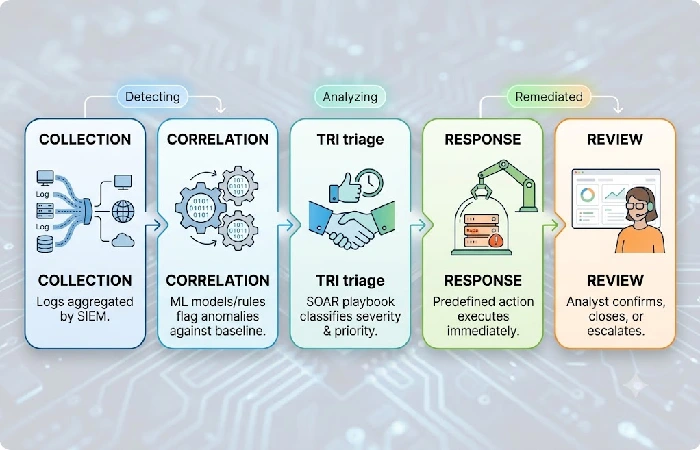
Automated threat detection and response, or ATDR, comes down to two systems handing off to each other. SIEM watches log and telemetry data, checking it against known threat signatures and behavioral baselines. Once something crosses that threshold, a SOAR playbook kicks in automatically. The human analyst reviews the output rather than doing every step.
The mechanical sequence:
- Collection: SIEM ingests logs from endpoints, network devices, and cloud services
- Correlation: Rules or ML models flag anomalies against baseline behavior
- Triage: SOAR playbook classifies severity and assigns priority
- Response: Predefined action executes — quarantine, block, alert escalation
- Review: Analyst confirms, closes, or escalates the case
Detection rule quality remains the persistent bottleneck in this pipeline. Per SANS survey data, 73% of respondents struggle with crafting quality and reliable detection rules — meaning the automation is only as good as the correlation logic feeding it, not the SOAR execution layer itself.
Benefits and risks
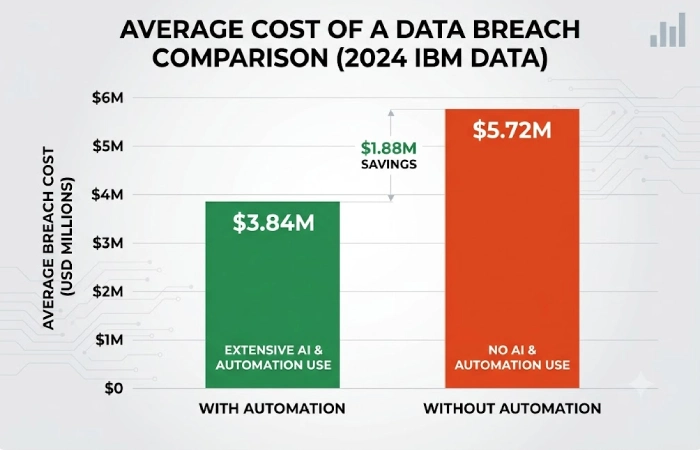
Automation’s measurable benefit is financial and speed-based, not just operational convenience. Organizations that deploy AI and automation extensively in security operations see quantifiably lower breach costs and faster containment than those that don’t.
Companies without extensive use of AI and automation experienced an average USD 5.72 million in costs per data breach versus USD 3.84 million for companies with extensive use, a USD 1.88 million difference per breach. According to the 2024 IBM Cost of a Data Breach Report
Documented benefits:
- $1.88M lower average breach cost with extensive AI/automation use
- Faster identification and containment timelines
- Reduced analyst alert fatigue on high-volume, low-complexity tasks
Documented risks:
- Automated actions execute immediately — misconfigured playbooks can disrupt production systems before a human catches the error
- Over-automating unproven workflows erodes analyst trust, leading teams to quietly revert to manual review
- Automation inherits the accuracy limits of underlying detection rules — most teams already report struggling with rule quality, drift, and coverage gaps, a problem well documented in SANS’ 2025 Detection & Response Survey
This benefit/risk profile supports a phased rollout rather than a wholesale platform switch — a strategy detailed further on the IT automation hub page.
Security automation best practices
The safest rollout sequence automates mature, high-confidence workflows first and expands only after those playbooks are validated in production. Skipping straight to full automation is the single most cited risk factor in the data above.
- Start with phishing and vulnerability workflows — highest current adoption (52% and 43%) means proven playbooks already exist
- Keep a human checkpoint on every new playbook for at least one full review cycle before removing oversight
- Audit detection rule quality quarterly — given how many teams already struggle here, unreviewed rules compound false positives
- Avoid activating multiple new automations simultaneously — this is what causes teams to lose trust and revert to manual review
- Track MTTD/MTTR before and after each rollout to confirm the automation is measurably shortening — not just shifting — response time
Teams building a Zero Trust or DevSecOps posture should treat automation expansion as an incremental, measured process tied to these checkpoints rather than a one-time platform migration.
Frequently asked questions
1. What is security automation?
Security automation is software that performs security tasks — detection, triage, response — that would otherwise require a human analyst to execute manually. It’s typically deployed through SIEM and SOAR platforms working together rather than a single standalone tool.
2. What tasks can be automated in cybersecurity?
Responding to Phishing (52% adoption), managing vulnerabilities (43% ), and enriching data (42% ) are the most widely adopted automated activities based on the SANS survey data. Automated response to an end to end incident is very low at 16% adoption.
3. Can security automation replace human analysts?
No — current data shows only 16% of organizations have fully automated response processes, and experts note that scaling automation too fast without human checkpoints causes teams to lose trust in the system and revert to manual review.
4. What is the difference between SOAR and SIEM?
SIEM collects and correlates security log data to identify anomalies and activates the response playbook upon detection of a threat by SIEM; SOAR acts as the next in the sequence or layers not as an alternative or competing tool.
5. Is security automation safe? What are the risks?
The primary documented risk is that automated actions are instant, and a faulty playbook can kill production if no human detects the misbehavior and intervenes in time. The second risk is over-automation that can destroy analyst trust for the system.