Published: September 3, 2026
Last Updated: October 1, 2026
IT teams spend measurable hours each week on repetitive config, patch, and ticket work that automation software eliminates. This guide breaks down the tools that actually solve that problem — by pricing model, use case, and open-source-versus-commercial tradeoffs — instead of ranking vendors by marketing budget.
Quick Answer: Node-based tools like Puppet Enterprise price by managed device. Platforms such as Atera and NinjaOne take a different route, charging per technician or per endpoint. Which model fits comes down to your team’s ratio of technicians to devices, not brand recognition.
Definition: IT automation tools are software that handles the routine backend work. Configuration, patching, monitoring, all of it running across a whole set of servers and endpoints, with no manual, repetitive human touch required to get any of it done.
At-a-glance comparison
| Tool |
Category |
Pricing model |
Best-fit use case |
Source-stamped data point |
| Ansible (Red Hat) |
Agentless config management |
Node-based subscription, quote-only |
Enterprises needing agentless, YAML-based orchestration |
Red Hat doesn’t publish a list price for Ansible Automation Platform — it’s sold on an annual, node-based subscription, priced by how many nodes you manage. Ansible Core itself stays free and open-source. |
| Puppet Enterprise |
Agent-based config management |
Per-node, tiered by support level |
Mature environments needing RBAC/compliance controls |
Puppet Enterprise’s cost depends on two things: how many nodes you’re managing and which support tier you pick. Standard runs $112 per node/year; premium runs $199. |
| NinjaOne |
RMM / endpoint automation |
Per-endpoint monthly subscription |
MSPs and internal IT managing distributed fleets |
The Essentials plan starts around $3 per endpoint per month. On G2, it’s rated 4.7 out of 5 across more than 1,600 real-user reviews. |
| Atera |
RMM + AI-assisted ticketing |
Per-technician subscription |
Small IT teams wanting AI-assisted resolution |
Atera backs its Robin AI agent with a performance guarantee: if Robin can’t independently resolve half of an enterprise’s Tier 1 and complex Tier 2 tickets in the first 90 days, the fees get waived. |
Methodology: Figures derived from vendor documentation and independent editorial testing (TechRadar, UpGuard) corroborated with publicly available information. Quote only values are represented as such not a guess.
What are IT automation tools?
IT automation products are software solutions that replace manual server, network, and endpoint tasks with scripted or policy-driven execution. These products are not a single product type but rather categories of software:
- Configuration management — Ansible, Puppet, and Chef enforce a defined system state across servers
- RMM (remote monitoring and management) — NinjaOne, Atera oversee and fix endpoints for MSPs and internal IT
- RPA (robotic process automation) — a distinct category, concerned with business-process work over infrastructure
Most of these page-one primers conflate the categories, putting ticketing systems and infrastructure orchestration tools on the same page as if their functions are equivalent. They don’t: a Puppet deployment manages server configuration drift, while an Atera deployment manages help-desk ticket volume. Confirming which category matches your actual bottleneck — infrastructure consistency or support-ticket load — is the first filtering step before comparing vendors.
Essential IT automation features
The core features that differentiate a true automation platform from a monitoring dashboard are policy enforcement, scripting depth, and escalation logic. Check for:
- Agentless vs. agent-based architecture — agentless tools (Ansible) need no software installed on managed nodes; agent-based tools (Puppet, NinjaOne) require a persistent client.
- Drift detection — automatically flags when a server’s actual state diverges from its defined configuration
- Cross-OS scripting — automatic patching across Windows, macOS, and Linux without user intervention, with support for auto-updating over 200 third-party applications in platforms like NinjaOne
- AI-assisted diagnosis — newer entrants like Atera’s Robin diagnose and fix issues directly on endpoints and determine whether a request needs an action, an approval, or an escalation
Feature checklists alone don’t predict fit — a platform with every box checked can still fail if it doesn’t match your team’s technical skill level.
Best tools by IT use case
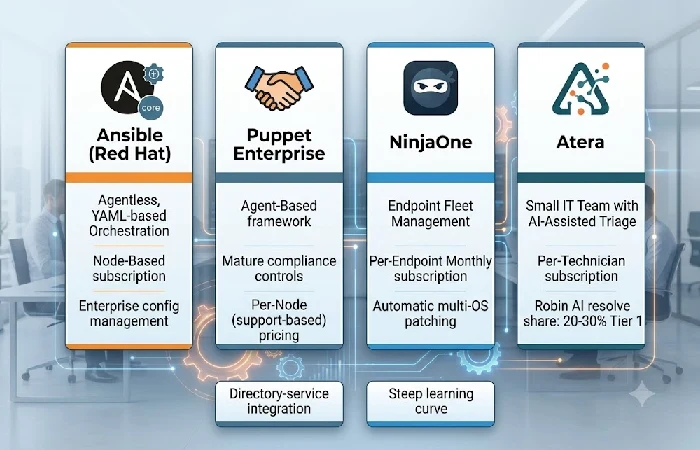
The right tool depends on whether your bottleneck is server configuration, endpoint fleet management, or help-desk ticket volume — not which platform has the longest feature list.
- For agentless, code-based infrastructure automation: Ansible fits teams comfortable writing YAML playbooks; Red Hat includes Private Automation Hub, Event-Driven Ansible, governance controls, and automation analytics in the subscription.
- For MSPs managing large device fleets: NinjaOne is built for endpoint automation; the tradeoff is a steep learning curve if you want to utilize most of the platform’s features.
- For small IT teams wanting AI-handled ticket triage: Atera’s Robin takes ownership of the request — investigating, deciding, executing approved actions, confirming the fix, and closing the loop — though Atera’s own documentation puts Robin’s independent resolution share at roughly 20 to 30 percent of routine level-one issues, a figure worth weighing against marketing claims.
- For compliance-heavy environments with existing agent infrastructure: Puppet Enterprise adds RBAC and directory-service integration on top of open-source Puppet.
No single tool wins across all four scenarios — the SERP-wide pattern of ranking one “best overall” tool ignores that node-based and per-technician pricing serve fundamentally different team structures.
Open-source vs commercial tools
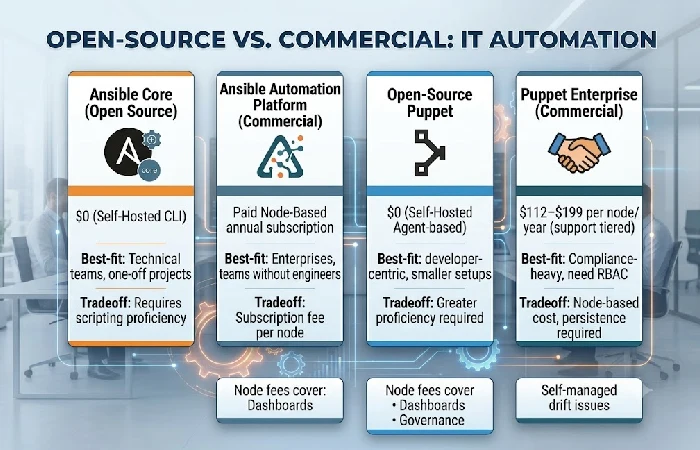
Open-source config management tools are free to run but do need in-house scripting capability. Commercial tiers add support, dashboards, and governance for a node fee. Price difference, not conjecture:
- Ansible Core is free and open-source for command-line automation, but the commercial Automation Platform requires contacting Red Hat or an authorized partner for a customized quote based on node count, support tier, and deployment model.
- Puppet Enterprise pricing runs $112–$199 per node/year depending on support tier, versus free open-source Puppet, which is best suited for smaller, developer-centric setups and “one-off” projects but requires greater technical proficiency to successfully manage.
Decision rule: if your team lacks dedicated automation engineers, the commercial tier’s support and governance tooling typically offsets its per-node cost faster than the labor cost of self-managing open-source drift issues.
How to select an IT automation platform
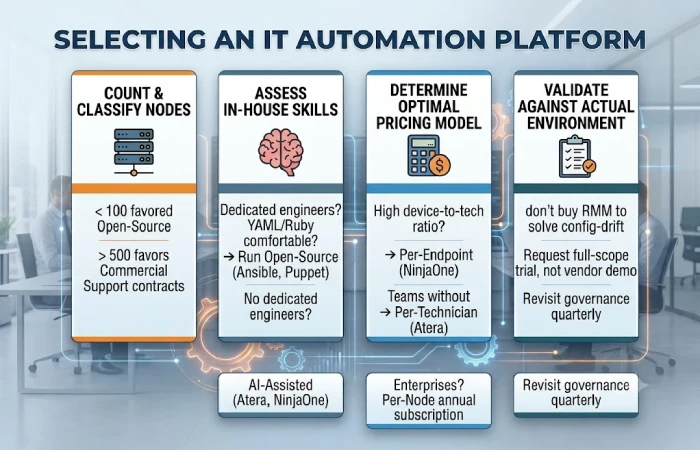
Match the platform to your node count, team skill level, and budget tier — not to whichever vendor ranks first in a search result. A practical selection sequence:
- Count your managed nodes/endpoints — under 100 nodes often favors free/open-source tiers; over 500 typically justifies commercial support contracts
- Assess in-house scripting skill — YAML/Ruby-comfortable teams can run open-source Ansible or Puppet; teams without dedicated automation engineers benefit from AI-assisted platforms like Atera
- Separate infrastructure automation from ticketing automation — don’t buy an RMM platform to solve a configuration-drift problem, or vice versa
- Request a trial against your actual environment, not a vendor demo, before signing an annual contract
For a broader view of how automation fits into your full IT operations strategy, see our complete IT automation guide.
Frequently asked questions
1. What is IT automation software?
IT automation tools automate configuration, patching, monitoring and ticket resolution on servers and endpoints, all without repetition. It is comprised of configuration management (Ansible, Puppet), RMM (NinjaOne, Atera) and RPA tools, each of which addresses a different operational bottleneck.
2. Is Ansible free?
Ansible Core for command-line automation, stays free and open-source. The complete Automation Platform is available as a paid, quote-based annual subscription per managed node.
3. What is the difference between RPA and IT automation?
RPA automates business-process tasks (data entry, form processing) at the application layer, while IT automation tools like Ansible and Puppet manage infrastructure state — servers, configs, and endpoints — a distinction most competitor listicles fail to draw clearly.
4. Is Puppet better than Ansible?
Neither one is per se “better.” Puppet offers separate agent-based and agentless frameworks, giving organizations more choice in how they automate. Ansible skips agents altogether — teams that want easier onboarding than Puppet’s deeper RBAC and directory-service integration tend to prefer it.
5. Which IT automation tool is best for a small business?
Smaller teams without automation engineers on staff tend to do better with per-technician RMM tools like Atera or NinjaOne. Code-based solutions like Ansible or Puppet require in-house scripting expertise that most small teams don’t have.