Published: August 11, 2026
Last Updated: August 24, 2026
In 2025, automated window coverings transitioned from luxury accessorizing to mainstream smart home upgrades, thanks to plummeting motor prices and the debut of Matter over Thread as a universal connectivity protocol. However, the 2026 landscape is crowded with retrofit curtain robots, bespoke roller shades, solar-powered motors, and ecosystem-locked hubs vying for the same consumer’s dollars. This guide cuts through the clutter with source-cited specifications and clear decision trees from determining which form factor complements your rooms to selecting which protocol to back and whether to retrofit or replace them.
Definition: “Motorized blinds and intelligent curtains – either on a timer, by voice activation, or through a smart-home application- give you an alternative to the manual pull cords that open and close window coverings by attaching sensors and protocols to the motors.”
Quick summary
- Best allround: SmartWings 231+ fabric choices, Matter/Thread/Zigbee supported,150–150–400 per window.
- Most future-proof: Eve MotionBlinds natively Matter 1.3 over Thread, no closed proprietary bridge needed,200–200–500.
- Most suitable for tenants: SwitchBot Curtain 3 – attaches to current rods without tools, under 25 decibels in silent mode,75-75-90 each unit.
- Best budget: IKEA FYRTUR simple motorized roller blind,130–130–230.
What is the difference between smart blinds and motorized curtains?
Smart blinds move vertically, rolling, folding, or tilting, and suit modern, minimal interiors where compact profiles and precise light control matter. Motorized curtains i.e. horizontal can be fitted on a special track, offering a less formal, more multi-layered feeling and design for bedrooms and large openings. You should select the style based on the room requirements and interior design, not because of the brand.
| Feature |
Smart blinds |
Motorized curtains |
| Movement |
Vertical — roll, fold, or tilt |
Horizontal — slide along a track |
| Aesthetic |
Clean, compact, minimalist |
Soft, warm, decorative |
| Best rooms |
Kitchens, bathrooms, home offices |
Bedrooms, living rooms, home theaters |
| Light control |
Precise — venetian slats adjust angle incrementally |
Typically binary — open or closed (unless paired with sheers) |
| Insulation strength |
Cellular (honeycomb) styles trap air in sealed pockets |
Heavyweight drapes block drafts but lack sealed air chambers |
The most successful combinations in 2026 put both, a motorized cellular shade for insulation, and light filtering behind a decorative motorized curtain for blackout and visual warmth. This combination works well in bedrooms where temperature and darkness are important.
How do Matter, Thread, and Wi-Fi protocols affect your smart blinds?
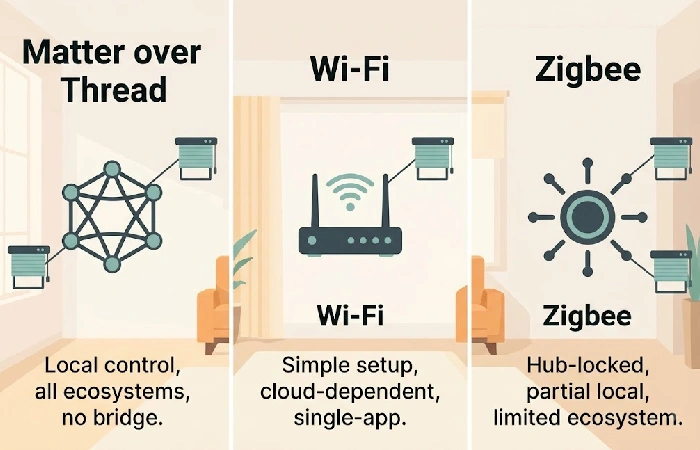
Matter over Thread is the protocol combination that prevents vendor lock-in and allows your blinds to work even if your internet drops out. Buying a Matter-certified motor in 2026 will allow you to use it with Apple Home, Google Home, Amazon Alexa, and Samsung SmartThings now and as new platforms integrate with the standard.
| Protocol |
Hub or bridge required? |
Works offline? |
Cross-ecosystem? |
Best for |
| Matter over Thread |
Thread Border Router only (already built into HomePod 2nd gen, Nest Hub, Apple TV 4K) |
Yes — local mesh network with no cloud dependency |
Yes — all major platforms |
Buyers who want long-term compatibility without collecting proprietary bridges |
| Wi-Fi |
No extra hub — connects to your router directly |
No — most features require active cloud connection |
Varies by brand and app |
Simple setups where strong 2.4 GHz Wi-Fi reaches every window |
| Zigbee |
Brand-specific hub (e.g., IKEA DIRIGERA, SmartThings hub) |
Partial — hub controls locally, but app access needs internet |
Limited to hub’s supported ecosystem |
Users already invested in a Zigbee-based hub |
Supporting Matter 1.3 over Thread natively, Eve MotionBlinds does not need a proprietary bridge, just a Thread Border Router already embedded in devices like the Apple HomePod (2nd Gen) or Google Nest Hub.
SwitchBot Curtain 3, instead, needs a separate SwitchBot Hub 2 (~$50) to bridge Bluetooth to Matter.
Which automated blinds and smart curtains worth buying in 2026?
Five products continue to appear across the top-10 search results and manufacturer documentation for 2026, representing five buyer types: SmartWings for deep customization, Eve MotionBlinds for protocol-level future-proofing, SwitchBot Curtain 3 for no-tools retrofit, IKEA FYRTUR for affordability, and Lutron Serena for high build quality.
Methodology: Selection criteria were ranking frequency in current top-10 search results, confirmed protocol compatibility, and specifications published on each manufacturer’s official site. Prices reflect U.S. retail ranges as of August 2026. No affiliate interests influence ordering.
| Product |
Best for |
Protocol |
Power |
Noise |
Price (USD) |
Key limitation |
| SmartWings |
Best overall — 231+ fabric and style options with broad ecosystem support |
Matter, Thread, Zigbee, Z-Wave, Wi-Fi (varies by motor module) |
USB-C rechargeable or hardwired; solar accessory available |
No independent dB rating published; user reports describe operation as quiet |
150–150–400 per window depending on size and fabric |
Motor module selection can confuse first-time buyers |
| Eve MotionBlinds |
Most future-proof — native Matter 1.3 over Thread, no proprietary bridge |
Matter 1.3 over Thread (native) |
Rechargeable battery; solar accessory available |
“Absolute Silence” technology (vendor claim; no third-party dB test published) |
200–200–500 per window; DIY Upgrade Kit ~80–80–120 |
HomeKit-to-Matter firmware upgrade is one-way and irreversible |
| SwitchBot Curtain 3 |
Best retrofit — clips onto existing curtain rods with no tools required |
Bluetooth by default; Matter requires SwitchBot Hub 2 (~$50 sold separately) |
USB-C rechargeable; up to 8 months per charge; optional solar panel ~$20 |
Below 25 dB in QuietDrift mode at 1 m distance (source: switch-bot.com) |
75–75–90 per unit; ~150–150–180 for a center-opening pair |
Requires separate hub for voice assistant integration; some users report internal gear wear after 12–18 months of heavy use |
| IKEA FYRTUR |
Best budget — accessible entry price for basic motorized roller shades |
Zigbee via DIRIGERA hub; Matter support added through DIRIGERA firmware update |
USB-C rechargeable |
No official dB rating published; user reviews describe motor as audible but not disruptive |
130–130–230 per shade; DIRIGERA hub ~$60 if not already owned |
Fixed sizes only — no custom-cut option; limited fabric and color range |
| Lutron Serena |
Best luxury — premium build quality with dedicated dealer support network |
Lutron Clear Connect RF (proprietary); requires Lutron Smart Bridge or Caséta hub |
Rechargeable battery or hardwired |
Industry-recognized as exceptionally quiet; no published dB figure |
350–350–700+ per window; Smart Bridge ~100–100–200 |
Locked into Lutron proprietary ecosystem; no Matter or Thread support; highest price point in this comparison |
Should you retrofit existing blinds or buy a full replacement?
Order retrofit if you rent, have a small budget, or just want to try automating smart windows in one room before automating your entire home. Order a full replacement if you own your home, want a clean look with no motor hardware showing, or need to custom fit a nonstandard window.
Retrofit path: The SwitchBot Curtain 3 can retrofit onto any U-rail, I-rail or rod-type curtain on a window (no wall modification, no tools). Conversely, the SwitchBot Blind Tilt is a similar control (permits horizontal venetian blinds to open and close using a mobile app) and costs about $70 a unit. The SwitchBot Blind Tilt is also deposit-proof for renters.
Full replacement path: SmartWings and Eve MotionBlinds: Custom cut shades fabricated to your exact window dimensions, with insulation on the headrail and the motor inside. These provide a clean, integrated look; a measurement, lead time (usually 5 – 10 business days to custom build) and permanent fasteners are needed.
How do battery, solar, and hardwired blind motors compare?
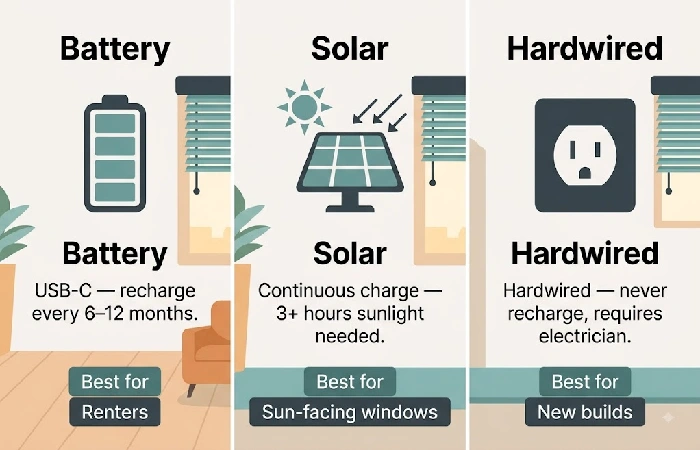
Battery operated motors are the simplest to fit and offer, therefore, the broadest appeal. Solar panels provide additional power for the batteries on sun facing windows and can completely remove the need for any human replenishing of charge. Hardwired motors are maintenance free but not convenient as they involve electrical work and are only viable during construction or redecoration periods.
| Power source |
Recharge cycle |
Best for |
Limitation |
| Rechargeable battery (USB-C) |
Every 6–12 months depending on daily open-close cycles |
Renters, DIY installers, retrofits |
Requires periodic recharging; frequency increases with heavy-fabric or multi-cycle use |
| Solar panel add-on (15–15–25) |
Continuous trickle charge; eliminates manual recharging on south-, east-, or west-facing windows |
Windows receiving 3+ hours of direct or bright ambient daylight daily |
North-facing windows and consistently overcast climates may not generate sufficient charge to maintain year-round motor operation |
| Hardwired (mains power) |
Never — always powered |
New construction, major renovations, commercial installations |
Requires in-wall wiring by a qualified electrician; not viable for renters or retrofit scenarios |
Cellular (honeycomb) shades paired with any motor type can reduce winter heat loss through windows by up to 40% and summer solar heat gain by up to 60%, according to the U.S. Department of Energy. No other blind type matches this insulation performance.
How do you set up automated blinds with Alexa, Google Home, or Apple Home?
Automated blinds, on average, will usually connect to a voice assistant in four steps: install the motor, configure it in the manufacturer’s app, enable the brand’s skill or integration inside your assistant’s app, and run device discovery. It takes between 10–20 minutes per window to set up.
Platform-specific differences to verify before purchasing:
- Alexa: Supports percentage-open commands (“Alexa, set bedroom blinds to 50%”) on the majority of Matter supported motors. On non-Matter devices, the brand-specific Alexa skill is needed, and percentage commands may not supported.
- Google Home: supports Matter at the native level. Percentage-open commands work with Matter-certified motors. Zigbee-only devices need to be controlled through a Google-compatible hub (eg, SmartThings).
- Apple Home: Needs Thread Border Router (HomePod mini or HomePod 2nd gen or Apple TV 4K). Provides the deepest local-control integration with Thread enabled motors including automation scenes that are 100% on-device.
The difference in feature-parity per platform is not documented by any of the current top-10 search results pages.
Frequently asked questions
1. Are motorized blinds worth the cost?
Yes for the typical home, the energy savings and increased ease of use of motorized blinds will justify their expense in 3–5 years. The strongest return comes from automating high-traffic rooms (bedrooms, living rooms) and hard-to-reach windows first, rather than upgrading every window at once. For the typical home, the best value: use motorized cellular shades (150–150–400) in main traffic rooms (bedrooms, living rooms) and hard-to-reach windows first.
2. Do smart blinds work without Wi-Fi?
Yes if they operate on Matter over Thread. Thread establishes a mesh network between your blinds and a Thread Border Router (HomePod, Nest Hub) so they still respond to scheduled automation routines, manual app interaction, and select voice commands when the network and internet is down. Wi-Fi only motors usually drop app and voice control when the router or internet are down, but an independent physical remote is still available.
3. Are automated blinds safe for children?
Yes. All motorized blinds remove the cords that have led to strangulation injuries and deaths of children. As of June 2024, every stock window covering sold in the United States must be cordless or have inaccessible cords, according to the ANSI/WCMA A100.1-2022 standard (source: U.S. Consumer Product Safety Commission). Every motorized blind here does.
4. How long do batteries last on motorized blinds?
Average for most rechargebale blinds motors is 6–12 months on a single USB-C charge assuming typical use(1 open-close cycle per day). SwitchBot Curtain 3 advertisement boasts up to 8 months per charge (source: switch-bot.com); IKEA FYRTUR for similar usage averages around 6 months (cumulative user reports). Integrating a manufacturer’s solar panel can effectively remove the need to ever recharge (15-15-25), (at minimum 3h of sun per day).
If you rent, begin with one SwitchBot Curtain 3 for your bedroom window. Installation takes fewer than 10 minutes, costs less than $90, and nothing needs to do to your walls. If you own your home and require a long-term solution, get your windows measured to order a set of SmartWings or Eve MotionBlinds bespoke shades with Matter-over-Thread motors. Both options tap into your existing smart Home automation plan.