Published: August 3, 2026
Last Updated: August 24, 2026
Smart home products have too often been designed for a single ecosystem – a bulb that connects to Alexa but not Apple Home, a thermostat that only talks to Google Home. Matter is designed to break down those barriers. Supported by 500+ organizations, from Apple and Amazon to Google and Samsung, and set by the Connectivity Standards Alliance, it is the open source protocol that provides all certified devices with a common vernacular. Over 4,000 products are currently Matter certified, and series 1.6 of the protocol has just been ratified. Here is everything you need to know about what Matter is, how it operates from a technical perspective, what has evolved over each version, and where it still fails.
Definition: “The Matter smart home protocol is the open source, Internet Protocol oriented standard created by the Connectivity Standards Alliance that allows devices from Apple, Google, Amazon, Samsung, and more than 500 other companies to interact locally over a common language.”
Quick answer: Matter is the smart home protocol that enables certified products of any brand to work in unison locally. Here is how it works in 2026.
What is the Matter smart home protocol?
Matter is an open-source IP-based application-layer protocol that allows disparate smart-home products from different manufacturers to work with any compatible ecosystem, such as Google Home, Apple Home, Amazon Alexa, or Samsung SmartThings without proprietary bridges or platform lock-in. The Connectivity Standards Alliance (CSA) announced the first specification for Matter (version 1.0) in October 2022.
Prior to Matter, interoperability meant that each vendor had to develop their own set of firmware integrations for each platform. A single smart plug may have had one code path for HomeKit and its own for Alexa. Matter reduces that down to a single certification: any device with the Matter symbol works across all Matter enabled controllers. It is royalty free and open source, so any device maker can get involved without licensing fees and this has helped the ecosystem grow from 0 to over 4,000 certified products in under four years.
How does Matter work?
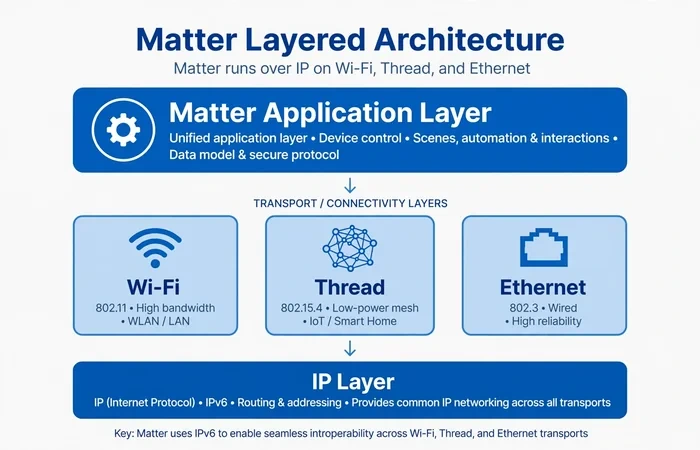
Matter is an application layer running above your current home network – it defines what devices say to each other, not how the data gets from one device to another. It allows homes to be operated on local networks rather than depending on commands traveling through the internet (cloud), allowing for less latency and no single point of failure.
Transport layers — Wi-Fi, Thread, and Ethernet
Matter is transmitted via three transport protocols. Wi-Fi easily meets the bandwidth needs of high-bandwidth peripherals, e.g., smart displays and video cameras. Thread, a low-power IPv6-based mesh network, serves range-extender devices, e.g., sensors, locks, and lightbulbs. All devices work as transceivers for signals, reaching other devices to extend range. Ethernet guarantees maximum reliability to hard-wired hubs and controllers. Bluetooth only for commissioning, i.e., setup, and not for runtime transport.
Local control and why it matters
As Matter runs over your home’s local IP network, its response times tend to be less than 100ms: indeed, this is significantly quicker than the protocol used by smart homes that depend on a cloud. Things will continue to respond even if your internet goes down, as the controller and device aren’t relying on a round-trip through the cloud.
Multi-admin support
One Matter device can be enrolled in several ecosystems at once. One intelligent socket can be visible on Google Home, Apple Home, and Alexa together with the same functionality enabled in every ecosystem, by the device consumers, using the ecosystem they prefer to use.
Matter vs Thread — what is the difference?
Matter & Thread are complementary, not competitive: Matter is the application-layer language that devices speak, and Thread is the network-layer roads that the language travels on. A device called “Matter over Thread” translates to a device that supports Matter for cross-platform interoperability over a network built on Thread, a low-power mesh network that heals itself.
Thread is an IPv6 mesh networking protocol operated by the Thread Group and built on the IEEE 802.15.4 radio standard. Unlike a Wi-Fi network in which every device talks to a main router, Thread devices bounce signals around nearby nodes, giving coverage without additional range extenders. If a node drops out, the mesh reconfigures itself to use alternative routes.
In order to connect Thread-based devices onto the larger IP network (and onto Matter devices running over Wi-Fi), you need a Thread Border Router, a feature integrated into most modern smart home hubs such as Apple HomePod mini, Google Nest Hub (2nd gen), and Amazon Echo (4th gen).
Matter version history — 1.0 through 1.6
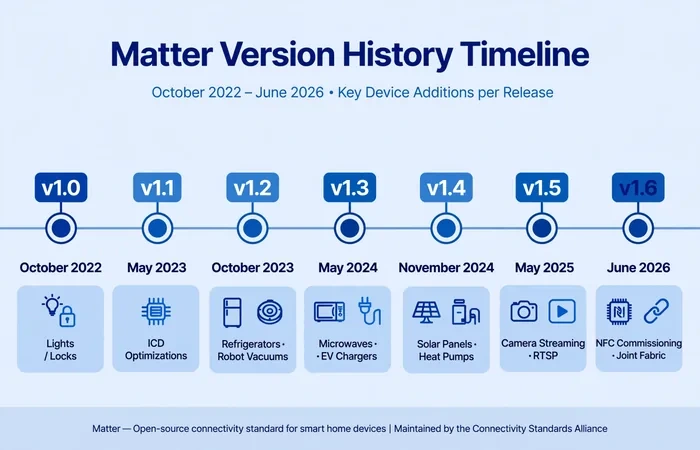
Matter has been refreshed six times since its October 2022 launch, with each spec release adding device classes and platform features to the set of supported configurations. The timeline below summarizes each iteration up until the present release.
| Version |
Release date |
Key additions |
| 1.0 |
Oct 4, 2022 |
Lights, plugs, locks, sensors, thermostats, media players; foundational IP-based architecture with multi-admin, end-to-end encryption, and Bluetooth commissioning |
| 1.1 |
May 18, 2023 |
Optimizations for battery-powered Intermittently Connected Devices (ICD); expanded developer tooling |
| 1.2 |
Oct 23, 2023 |
9 new device types including refrigerators, robot vacuums, air purifiers, washing machines, and smoke/CO alarms |
| 1.3 |
May 8, 2024 |
Microwaves, ovens, cooktops, dryers, EV chargers, water leak/freeze sensors; scene automation (multi-device presets); device-level energy consumption reporting |
| 1.4 |
Nov 7, 2024 |
Solar panels, home batteries, heat pumps, water heaters; Home Router/Access Point (HRAP) support for Wi-Fi routers as native Matter controllers |
| 1.5 |
Nov 20, 2025 |
Native camera streaming via RTSP over Wi-Fi or Ethernet — the most requested device category since Matter 1.0 |
| 1.6 |
Jun 17, 2026 |
NFC-based commissioning (tap a phone to set up hard-to-reach devices like ceiling lights); Joint Fabric allowing multiple controllers to share one network fabric; Thermostat Suggestions for predictive climate automation |
Which devices are compatible with Matter in 2026?
More than 4000 products from hundreds of manufacturers now bear the definitive Matter certification across virtually every mainstream smart home category. The ecosystem is comprised of:
- Lighting: Philips Hue, LIFX, Nanoleaf, and many other brands have native support for Matter or will have firmware update support.
- Climate control: Nest Thermostat (4th generation), Ecobee, Aqara thermostats that support Matter-over-Thread
- Sensors & switches: Contact, motion, temperature and humidity sensors from Aqara, Eve and other brands all using Thread except where noted for power saving.
- Camera security: Built in since Matter 1.5 (November 2025) over Wi-Fi or Ethernet with RTSP streaming
- Major home appliances: Refrigerators, ovens, washing machines and robot-vacuums by Samsung, LG and other (added in versions 1.2 and 1.3)
- Energy management: Solar inverters, home batteries, and EV chargers (where added in 1.4)
To confirm a certain product has gone through formal CSA certification, not just been “announced” or labeled “Matter ready,” search the CSA database directly (see link in the FAQ below).
Do you need a hub for Matter?
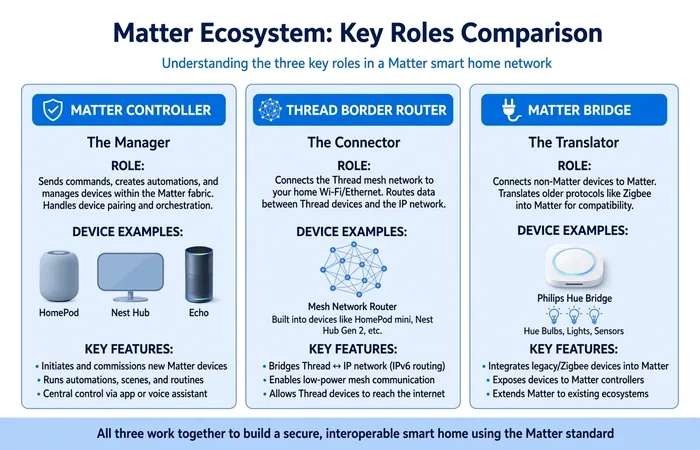
Absolutely at a bare minimum, you will need at least one Matter controller to configure, manage, and control devices through a mobile or a voice assistant. Chances are your home already has one. There’s a lot of confusion about the use of the word “hub” in Matter. Here are three different types of hardware.
- Matter controller: The system providing your smart home platform that is sending commands to Matter devices. Examples: Apple HomePod mini, Google Nest Hub (2nd gen), Amazon Echo (4th gen), Samsung SmartThings Station. At least one is necessary for any Matter installation.
- Thread Border Router: Connects your Thread mesh network to your home Wi-Fi and IP network. Needed only if you will be using Thread-only devices (sensors, locks, battery-powered bulbs). A large number of Matter controllers- the HomePod mini and Nest Hub are two- are also Thread Border Routers.
- Matter bridge: A hub branded by its manufacturer that translates unsupported legacy devices into Matter. For example, the Philips Hue Bridge exposes its Zigbee-enabled bulbs as Matter-visible devices; needed solely for legacy products without native Matter firmware.
See the pillar guide to get a broader view of which controllers and platforms are Matter-ready smart home hubs and voice assistants.
Current limitations and known issues
Matter has come a long way from v1.0, but there are still documented friction points that competing guides tend not to mention. For current issues, reported on user forums, manufacturer support notes, and CSA developer documentation, please see:
- Commissioning failures; QR-code scanning and NFC tap-to-pair can just time out without error messages when adding a device to a second or third ecosystem through multi-admin pairing.
- ‘Matter-ready’ vs. ‘Matter-certified’ confusion in labels: some manufacturers pre-label products ‘Matter-ready’ prior to completion of formal CSA certification testing; these devices do not yet have full interoperability until a future firmware release.
- Thread Border Router conflicts: Homes with more than one Border Router (e.g. a HomePod mini and a Nest Hub) at the same time may see unstable routing behavior when the routers fight to be the mesh leader.
- Feature limitations in Matter mode: Additional functions that may be available in the native app, such as custom color scenes, highly detailed scheduling, or manufacturer-specific automations, are often pared down to simple on/off/dim commands in Matter mode.
- Local network needs: Matter needs a local network that is reliable, IPv6 capable and has a working multicast DNS (mDNS). If the VLANs are not properly set up, routers are running an overly aggressive firewall or consumer mesh Wi-Fi is in use and isolate IoT to a separate subnet, and device discovery can be completely blocked.
Frequently asked questions
1. Does Matter work without internet?
Yes, but only for commands from your home. Matter runs on your home’s local IP network, thus on/off, dim, lock/unlock, and thermostat-control commands occur without internet. Remote access commands from outside your home and cloud-based automations based on outside data (weather, geolocation) do not.
2. Is Matter better than Zigbee?
Matter and Zigbee reside at different protocol layers and are not directly compatible. Zigbee is a complete protocol stack implementing network and application logic whereas Matter is an application-level protocol that runs over Thread, Wi-Fi or Ethernet. Thread, which is the low-power mesh transport protocol that Matter uses, is the successor protocol to Zigbee at the networking layer and uses the same IEEE 802.15.4 radio protocol. Zigbee devices can connect into a Matter ecosystem via manufacturer bridges; Philips Hue Bridge, for instance, maps their entire Zigbee bulb range into a set of Matter-visible devices.
3. How do you check if a device is Matter-certified?
Search for the official Matter logo displayed on the package or retailer listing. To verify certification status independently, perform a search in the CSA Certified Products Search database by entering product name, manufacturer, or device category. Only products that have undergone official CSA interoperability and security testing will display in this database. If a product appears on a third-party tracking site but not within the CSA database, then it does not yet have certification.