Published: July 18, 2026
Last Updated: September 18, 2026
You already know which games you want to replay. The hard part is picking a device when there are 50-plus options on the market and every guide seems to recommend something different.
Some of those options are $30 handhelds shipped straight out of Shenzhen. Others are $220 FPGA machines that recreate your original cartridges at the hardware level. And a surprising number are outright knockoffs that can’t hold a steady frame rate through Super Mario Bros. That spread, not some abstract question of “what counts as retro,” is the actual problem you’re solving.
So here’s what you’re getting: a short, opinionated list of consoles worth your money right now, sorted by budget and use case, with pricing for both the US and India.
Key points: Budget decides your era here. Around $220 buys FPGA accuracy — the Analogue Pocket recreates original cartridges at the hardware level. Drop to $130 for the Retroid Pocket 5, an emulation handheld spanning multiple console generations, or $55 for the Miyoo Mini Plus covering the same ground cheaper. Want zero setup and a TV connection? That’s the Evercade EXP, around $60. Spend more, get more accuracy. Spend less, and you’re trusting software to fake it.
What Retro Gaming Consoles Actually Look Like in 2026
Three real paths exist, and they don’t overlap as much as buying guides pretend.
FPGA consoles replicate original hardware at the circuit level. No software emulation, no shortcuts. That buys near-perfect accuracy and native cartridge support — the tradeoff is price. At $220, the Analogue Pocket is the flagship here, and nothing else comes close.
Software, not silicon, is what powers emulation handhelds. Cheaper, more flexible, and capable of spanning multiple console generations on one device. Accuracy dips on a handful of finicky titles, but across 95% of what you’ll actually play, you won’t notice the difference. Anbernic, Retroid, and Miyoo own this space.
Plug-and-play consoles come preloaded, or run on proprietary cartridges loaded with licensed games — flexibility isn’t the point here, ease is. Turn it on and plug in the HDMI cable; play starts almost immediately.
Grand View Research pegs the global plug-and-play and retro console segment at $4.38 billion in 2024, climbing toward $6.10 billion by 2033 at a 3.5% CAGR — driven largely by adults in their 30s and 40s buying back their childhood, one handheld at a time.
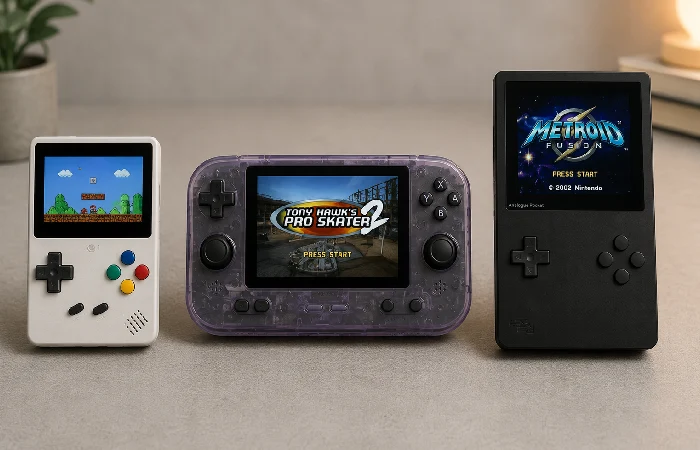
Retro Handhelds Worth Buying Right Now
| Category |
Device |
Best for |
Price (US) |
Price (India, est.) |
| Budget |
Miyoo Mini Plus |
8-bit/16-bit/PS1, pocket-sized |
~$55 |
₹5,000–₹6,500 |
| Mid-range |
Retroid Pocket 5 |
N64, Dreamcast, some PS2 |
~$130 |
₹12,000–₹15,000 |
| Premium |
Analogue Pocket |
Original Game Boy/GBA carts, FPGA |
~$220 |
₹22,000+ (import) |
Under $60: The Miyoo Mini Plus
This is where most people should start, full stop. It fits in a jacket pocket and runs everything from NES through PS1 without complaint. That’s Onion OS at work — community firmware taking an already capable device and making it genuinely polished. Five to six hours of battery, and a 3.5-inch IPS screen that holds up fine for 2D sprites.
But be honest about the ceiling here. N64, Dreamcast, PSP — anything past PS1 — runs poorly here, if it runs at all. Stop at the 32-bit era and none of that matters to you. Chasing 3D titles instead? Keep scrolling.
In India, the Miyoo Mini Plus runs about ₹5,000 to ₹6,500 through resellers like ElectroniksIndia or LitNXT. Skip the “400-in-1” knockoffs floating around Flipkart and Amazon India — they look identical in the product photos and perform nothing alike once you turn them on.
$100–$150: An Emulator Console for Classic Games
The Retroid Pocket 5 handles the jump into 3D-era games that cheaper devices simply can’t touch. N64 runs well. PSP runs well. Dreamcast runs well. PS2 and GameCube are hit-and-miss depending on the specific title, but roughly 60–70% of the popular library plays cleanly.
It runs Android, so you get RetroArch plus standalone emulators plus cloud gaming apps, if you’re into that. That flexibility comes at the cost of a steeper learning curve than a plug-and-play box — plan on spending about 30 minutes setting it up the first time.
Anbernic’s RG556 sits in the same price bracket and performs comparably. Pick based on form factor: the Retroid is horizontal, like a PSP; the RG556 leans more traditional.
The Premium Pick: Analogue Pocket
Here’s the part most people get wrong. They assume the Analogue Pocket is just an expensive emulator wearing nicer plastic. Wrong on both counts — this is an FPGA device, recreating Game Boy, Game Boy Color, and GBA hardware directly in silicon, and your actual cartridges slot right in. Call the accuracy 1:1; the gap is too small to argue about.
That accuracy costs $220, and out of the box it only plays cartridge-based handhelds natively. You can load additional FPGA “cores” for NES, SNES, or Genesis, but those require separate downloads and a bit of patience. For a Game Boy purist with a cart collection already gathering dust in a drawer, nothing else on this list comes close — and this is the one case on this page where the more expensive option is simply the right call, not just the safer-sounding one.
Market context is worth a beat here. Between 2020 and 2024, Anbernic alone moved about 1.25 million units, good for roughly 32.7% of the retro handheld market. Powkiddy trailed at 900,000, Retroid at 730,000 — numbers that say this stopped being a niche hobby a while back. These companies are shipping real volume.
Best Retro Consoles for Your TV
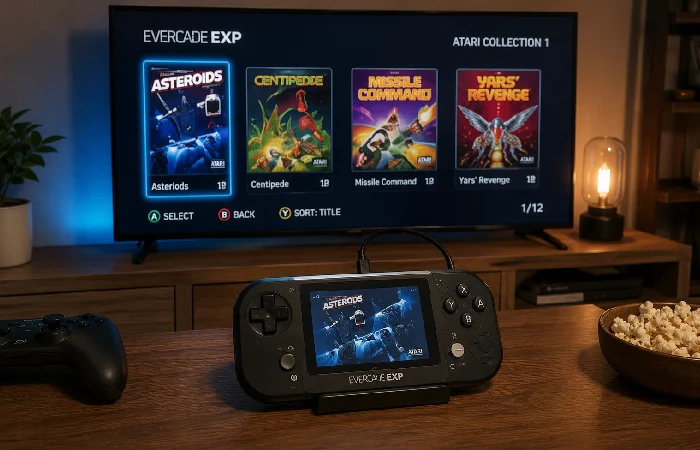
Not everyone wants a handheld. If you’re connecting to a TV, two paths make sense.
Plug-and-Play Picks: Mini NES and SNES Classic Alternatives
Nintendo killed both the NES Classic and SNES Classic years ago, and the secondary market hasn’t been kind since — inflated prices chasing libraries that were thin even at launch.
The Evercade EXP is the closest replacement that actually delivers. It runs on licensed cartridge collections — Atari, Namco, Capcom, Intellivision — with each cart holding 6 to 20 games. No ROM sourcing, no configuration, no legal gray zone. Buy a cart, slot it in, play. HDMI output works with any modern TV.
The Super Pocket, from the same Evercade ecosystem, goes even simpler: preloaded Capcom or Taito collections, fits in your hand, connects to a TV over USB-C to HDMI if you want the bigger screen. Runs around $60. And if your 4K streaming setup is already handling the smart TV side of things, a plug-and-play console like this one slots in beside it without adding any real complexity.
FPGA Home Systems for Collectors
Original N64 cartridges, up to 4K, on a modern display — that’s the $250 Analogue 3D’s whole pitch. The Analogue Duo runs the same play for TurboGrafx-16 and PC Engine games.
These are collector-grade machines, not a general recommendation. If you don’t already own physical N64 or TurboGrafx cartridges, the value proposition doesn’t apply to you at all. If you do, this is the cleanest way to play them on a current TV without the lag and smear of old composite cables.
Controllers That Work for Retro Gaming on PC
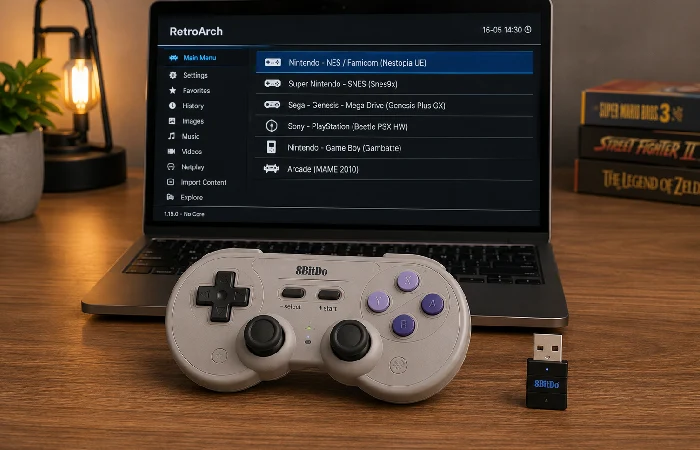
A good controller matters more than people give it credit for. Keyboard input is fine for turn-based RPGs. It’s genuinely bad for platformers.
The 8BitDo Ultimate 2C is the current sweet spot at around $30. Hall Effect joysticks mean no stick drift, ever. 2.4GHz wireless via the included USB dongle. Instant X-Input compatibility on Windows. Plug in the dongle, turn on the controller, and you’re playing.
Want the retro button layout specifically? The 8BitDo Pro 2 has the SNES-style shape and works across PC, Switch, and Android for about $50. It runs Bluetooth, which introduces slightly more input lag than the 2.4GHz dongle — for retro games, though, that lag is imperceptible, so don’t let it talk you out of the layout you actually want. Pairing either controller with a set of wireless gaming headsets turns a basic PC emulation setup into something that feels intentional rather than cobbled together.
Picking the Right Console Without Wasting Money
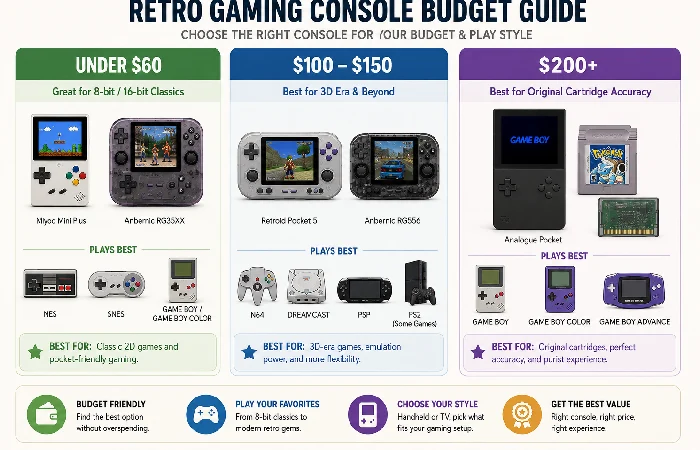
Here’s the framework most buying guides skip entirely. The real question isn’t “which console is best.” It’s which games you actually want to play, and what it costs to play them well.
Under $60 gets you flawless 8-bit, 16-bit, and PS1 emulation — NES, SNES, Genesis, Game Boy, PS1. Any device at this price handles these without issue, so don’t overspend on games from this era; you’re paying for a brand name at that point, not better performance.
$100–$150 gets you into 3D. N64, PSP, and Dreamcast play reliably. Some PS2 and GameCube titles work, but expect 60–70% compatibility, not full coverage.
$200 and up is for specific needs: FPGA accuracy for original cartridges, or high-end Android handhelds pushing PS2 compatibility past 80%. At this price point, know exactly what you’re buying and why before you click purchase.
Buying from India means the import markup is real, not theoretical. A $55 Miyoo Mini Plus runs ₹5,000 to ₹6,500 from a legitimate reseller. A $130 Retroid Pocket 5 runs ₹12,000 to ₹15,000. Stick to known sellers — ElectroniksIndia, LitNXT, Furper — and steer clear of anything marketed as “400-in-1” or “10,000 games built-in” on Amazon or Flipkart. That’s generic hardware running choppy emulation with zero community firmware support behind it.
Frequently Asked Questions About Retro Gaming Consoles
1. Are retro gaming consoles worth buying in 2026?
Depends on whether you already know what you want to replay. If you do, yes — a $55 handheld puts thousands of 8-bit and 16-bit titles in your pocket, at a value per dollar modern games can’t touch. Buy blind, without a console generation in mind, and that’s exactly how people end up wasting money.
2. What’s the best retro gaming console for beginners?
Miyoo Mini Plus with Onion OS. Under $60, fits anywhere, plays NES through PS1 without any real configuration headache.
3. Can you play retro games on a modern TV with HDMI?
Yes. Evercade EXP and Super Pocket go straight over HDMI; Analogue 3D pushes that up to 4K on the FPGA side. Handhelds usually manage TV output too, through a USB-C to HDMI adapter — just confirm the specific model supports it before you assume.
4. Is game emulation legal?
The software itself, yes. Where it gets murky is ROMs for games you don’t own — and enforcement swings wildly by country. Stick to games you physically own, licensed collections like Evercade carts, or Nintendo Switch Online, and you’re on safe ground.
5. What replaced the NES Classic and SNES Classic?
Nothing, officially — Nintendo discontinued both and never filled the gap. Your 2026 options: the Evercade EXP, the Super Pocket, or a budget handheld like the Miyoo Mini Plus running the full NES and SNES libraries in software.
6. Which retro console plays N64 and PS2 games?
N64 splits two ways: the $130 Retroid Pocket 5 covers most titles through emulation, while the $250 Analogue 3D plays original carts natively via FPGA. PS2 is tougher — you need a $150+ Android handheld, and even then, plan on 60–70% compatibility rather than full coverage.
7. Where can I buy retro gaming consoles in India?
Specialized resellers, not the big marketplaces. ElectroniksIndia, LitNXT, and Furper stock legitimate Anbernic, Miyoo, and Retroid hardware, typically at 20–40% above US MSRP once import duties and reseller margins are factored in. Skip the generic “retro console” listings on Flipkart and Amazon India.
Which One Should You Actually Buy
Here’s the real question: how much are you willing to spend to stop tolerating input lag? Under $60, you’re trading nothing — 8-bit and 16-bit play flawlessly regardless of price. Past that, every extra dollar buys accuracy you may or may not actually notice. Got a stack of Game Boy carts already gathering dust? The Analogue Pocket’s $220 price tag earns its keep. Nobody’s carts to speak of, though, and the smarter move is pocketing that difference and grabbing the Retroid Pocket 5 instead.