Published: September 8, 2026
Last Updated: September 8, 2026
An industrial automation system uses programmed controllers, sensors and actuators to replace manual machine operation and run a production line with limited involvement by a human. Depending on the production volume and how often the line will be required to change over, a manufacturer can choose between a fixed, programmable or flexible architecture. This article explains the main components, manufacturing applications for the three automation types and provides a simple framework for making the right decision.
Quick Answer: Industrial automation systems combine PLCs, SCADA, DCS and HMIs to control machinery via fixed, programmable or flexible architectures — the right choice depends on I/O count and changeover frequency.
Definition: An industrial automation system is a group of controllers (PLCs, DCS, or SCADA), sensors, and actuators which work together to run machinery and processes with little direct human involvement.
How PLC, DCS, SCADA, and HMI Compare
| System/Type |
Control layer (ISA-95) |
Typical response time |
Best-fit use case |
| PLC (Programmable Logic Controller) |
Level 1–2 direct control |
Sub-second, real-time |
Discrete manufacturing with 16–256 I/O points and repetitive machine control |
| DCS (Distributed Control System) |
Level 1–2 direct control |
Sub-second, real-time |
Continuous process industries (chemical, oil & gas) requiring centralized, redundant control |
| SCADA |
Level 2 supervisory control |
Seconds to minutes |
Remote monitoring across geographically dispersed assets (pipelines, utilities) |
| HMI |
Level 2 supervisory interface |
Real-time operator view |
On-site visualization and manual override for PLC/DCS processes |
| Fixed automation |
Level 1 (hard-wired) |
N/A — mechanical sequencing |
High-volume, unchanging production lines |
| Programmable automation |
Level 1–2 |
Reprogram cycles in hours |
Batch runs requiring periodic changeover |
| Flexible automation |
Level 1–2, dynamic reconfiguration |
Reprogram cycles in minutes |
Low-volume, high-mix manufacturing |
Methodology: Rows are based on publicly available information and third-party sources covering the ISA-95 control hierarchy and standard fixed/programmable/flexible automation taxonomy.
What is an industrial automation system?
Industrial automation gets talked about like it’s complicated, but the hardware is three things: controllers, sensors, and actuators running as one system. The manual stuff, switching, adjusting, timing, the system takes care of it. The programmed logic handles that, responding to real-world conditions on the floor as they happen.
These systems operate in one of two control modes:
- Closed-loop control: sensors feed readings back to the controller, which adjusts the process on its own – no operator input needed while the cycle runs.
- Open-loop control: the controller follows a fixed sequence from start to finish and won’t self-correct – if the outcome needs changing, an operator has to do it manually.
On most factory floors today, closed-loop control handles the continuous stuff – temperature, pressure, flow. Open-loop gets saved for straightforward, repetitive tasks like conveyor indexing. To get an overview of how those systems fit into a plant-wide strategy, check out this industrial automation guide.
Main components of automation systems
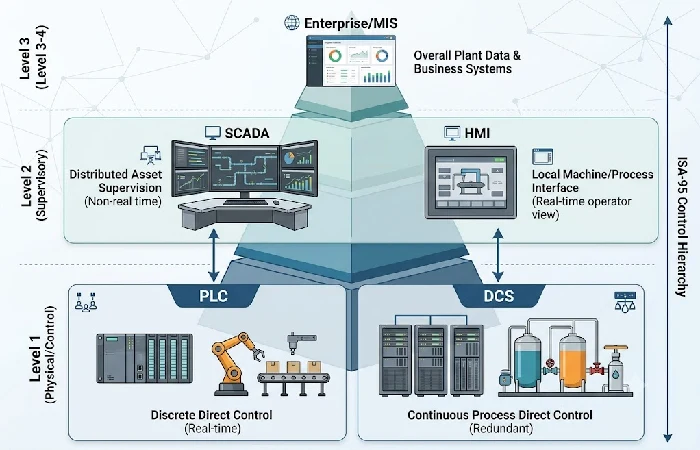
The hardware backbone of any industrial automation system is the PLC, DCS, SCADA and HMI layer, which each exists on a different rung on the standard control hierarchy. They work together to take data from the physical process, make a decision and provide the operator a means to observe and override that decision.
- PLC (Programmable Logic Controller): handles discrete, real-time machine control. Usually 16-256 I/O points per device.
- DCS (Distributed Control System): controls continuous processes with numerous control loops with centralized redundancy, typical in chemical and oil & gas plants.
- SCADA: Data collection and supervision across distributed assets is what SCADA handles. Think pipelines, water utilities, any infrastructure spread across geography. Response cycles run in seconds to minutes, not in real time.
- HMI (Human-Machine Interface): Operators interact with the PLC or DCS layer through the HMI. It’s the screen on the floor showing live process data. If something needs manual correction, that’s where the override happens.
Where each component sits is defined by the ISA-95 standard, which places PLC and DCS at direct control (Level 1–2) and SCADA at supervisory control (Level 2). Cross-vendor communication between these layers increasingly relies on OPC UA, a vendor independent protocol maintained by the OPC Foundation – a deliberate alternative to proprietary vendor stacks.
Fixed vs programmable vs flexible automation
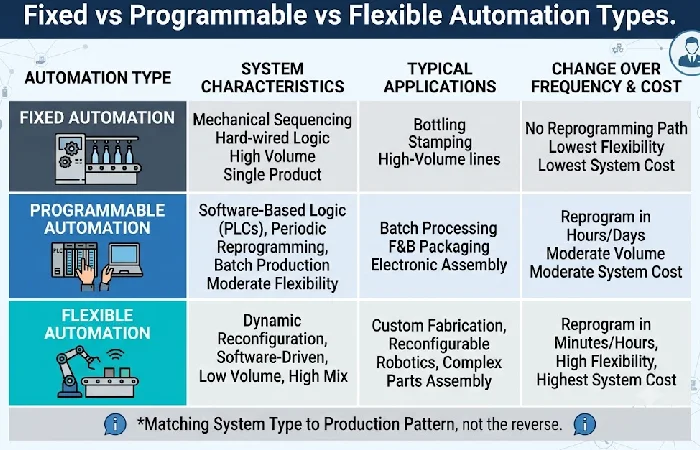
The right automation type depends on production volume and how often the line needs to change over — not on which system is generically “better.” Fixed automation suits unchanging high-volume runs; programmable suits periodic batch changeovers; flexible suits frequent, low-volume variation.
- Fixed automation: hard-wired, mechanical sequencing with no reprogramming path — used for bottling, stamping, and other high-volume lines that never change.
- Programmable automation: reprogrammed in hours between batches — suited to production runs with periodic product-variant changeover.
- Flexible automation: reconfigured in minutes via software — built for low-volume, high-mix manufacturing such as custom fabrication.
A practical rule: if changeover happens less than once a quarter, fixed automation is typically the lowest-cost option; if changeover happens weekly or more, flexible automation’s reconfiguration speed offsets its higher upfront system cost.
Common industrial applications
Industrial automation systems are applied wherever a process needs consistent, repeatable control — from discrete parts assembly to continuous chemical processing. The system type used depends directly on the production pattern of that industry.
- Automotive: welding/stamping lines use fixed automation; programmable automation (via PLC) for changeover between vehicle trim variants.
- Chemical/oil & gas processing: DCS-based continuous control of numerous interdependent loops (temperature, pressure, flow).
- Water/utility infrastructure: SCADA-based remote monitoring across dispersed, unmanned sites.
- Food and beverage packaging: PLC-driven programmable automation to change from one package size or formula to another.
- Electronics and custom fabrication: flexible automation for low volumes with high-mix orders – reconfigurable robotics.
Each application maps directly back to the ISA-95 control layers and the fixed/programmable/flexible taxonomy covered above — matching system type to production pattern, not the reverse.
How to select an automation system
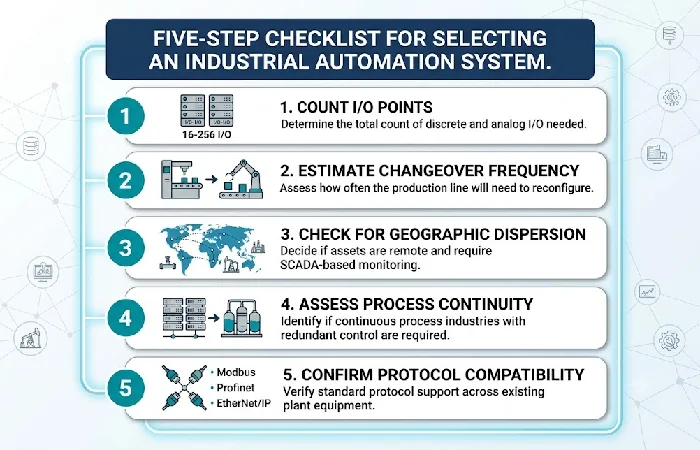
Choosing an automation system starts with counting I/O points and estimating changeover frequency — not with picking a vendor first. These two variables determine whether a PLC, DCS, or SCADA-based architecture fits the application.
A practical selection checklist:
- Count discrete and analog I/O points. Under 256 I/O with modest motion needs typically fits a compact PLC.
- Estimate changeover frequency. Less than quarterly favors fixed automation; weekly or more favors flexible automation.
- Check for geographic dispersion. Remote or distributed assets favor SCADA over a purely local PLC/HMI setup.
- Assess process continuity. Continuous chemical/process industries with many interdependent loops favor DCS over PLC.
- Confirm protocol compatibility. Verify Modbus, Profinet, or EtherNet/IP support across existing plant equipment before purchase.
For organizations planning automation beyond the factory floor into IT-managed workflows, review this IT automation strategy for how OT and IT automation stacks integrate at the enterprise level.
Frequently asked questions
1. What are the 4 types of automation?
Most classifications put industrial automation into four types: fixed, programmable, flexible, and integrated. Fixed is built for high-volume lines that never change. Programmable handles batch runs where changeovers are part of the job. Flexible is the pick when product mix is high and volumes are low. Integrated is a different category altogether. It’s about connecting PLC, SCADA, and DCS into one plant-wide control setup rather than describing a production style.
2. What differentiates PLC, SCADA and DCS?
A PLC handles discrete, real-time machine control at the direct-control layer. A DCS manages continuous processes across many control loops with centralized redundancy. SCADA supervises and collects data from dispersed assets on a seconds-to-minutes cycle, not for controlling machinery in real time.
3. Is SCADA a type of PLC?
No. SCADA doesn’t sit in the same category as a PLC. What it does is collect and display data from PLCs, remote terminal units, and other field devices. Sending machine control commands isn’t part of what it does.
4.Which is the best automation system to install in the factory?
The five-step checklist above is worth going through before you commit to anything. I/O count gets you most of the way there, but changeover frequency and whether the process runs continuously or in batches will narrow it down. Locking into a vendor’s product line before working through those factors is how you end up over- or under-specced.