Published: September 9, 2026
Last Updated: September 9, 2026
Artificial intelligence is divided into two different groups, and most explainers only mention one of those groups. These groups split AI either by ability or by function. By ability, you’ve got three types: Artificial Narrow Intelligence (ANI), Artificial General Intelligence (AGI), and Artificial Superintelligence (ASI). Function is a longer list, four of them this time, Reactive Machines, Limited Memory AI, Theory of Mind AI, Self-Aware AI. Knowing both these groups, and their relation to each other, is the difference between knowing reality and repeating a word you’ve seen in a headline.
Quick answer: AI really comes down to two different ways of sorting it. One’s about capability, so ANI, AGI, ASI. The other’s about function, running from reactive systems up to self-aware ones.
Definition: Two systems here. Capability-based covers Narrow, General, and Superintelligence. Function-based runs from Reactive Machines up through Limited Memory, Theory of Mind, and finally Self-Aware AI. Right now though, Narrow is the only one that actually exists.
What Are the Main Types of Artificial Intelligence?
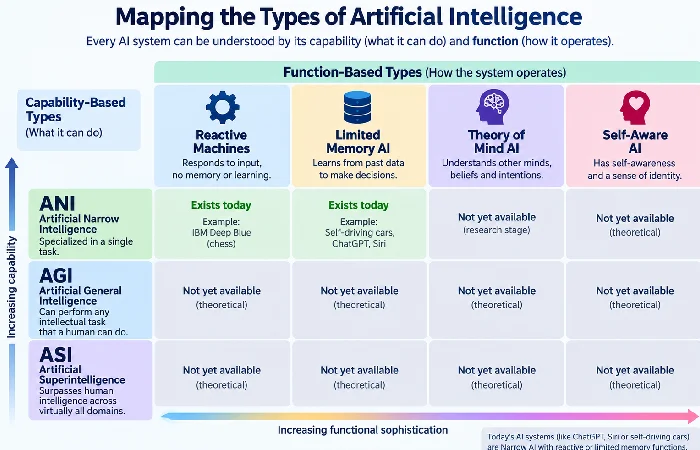
It divides into two different classification schemes, something most explainers never actually connect for you. One’s about ability, ANI, AGI, ASI, ranked by how far the intelligence reaches. The other’s about how the system actually operates day to day: Reactive Machines, Limited Memory AI, Theory of Mind AI, and eventually Self-Aware AI, if that ever gets built. Here’s how they compare, since every AI system in use today sits in the space between narrow and reactive or limited memory:
| AI type |
Classification system |
Currently deployed? |
Real-world example |
| Artificial Narrow Intelligence (ANI) |
Capability |
Yes — the only type in production use as of September 2026 |
Siri, Alexa, ChatGPT |
| Artificial General Intelligence (AGI) |
Capability |
No — theoretical |
None exists yet |
| Artificial Superintelligence (ASI) |
Capability |
No — theoretical |
None exists yet |
| Reactive Machines |
Function |
Yes — foundational, still in use |
IBM Deep Blue |
| Limited Memory AI |
Function |
Yes — most common function-type in production today |
Self-driving car perception systems |
| Theory of Mind AI |
Function |
No — conceptual research target |
None exists yet |
| Self-Aware AI |
Function |
No — speculative |
None exists yet |
Methodology: deployment status is based on cross-referencing IBM, Syracuse iSchool, and GeeksforGeeks classification pages against currently operating AI products as of September 2026. A type counts as “deployed” only if a named, functioning system meets the definition without qualification.
What Are the Main Types of Artificial Intelligence?
AI is classified two ways at once, and conflating them is where most confusion starts. Artificial Narrow Intelligence, also called Weak AI, is the only type of AI that exists today, trained to perform a single or narrow task, often faster and better than a human mind can, though it can’t perform outside that defined task. That’s the capability axis. Separately, there’s a function axis describing how an AI system processes information: Reactive Machines, Limited Memory AI, Theory of Mind AI, and Self-Aware AI, a breakdown IBM lays out in more detail.
Here’s the connection competitors skip: every ANI system in production today is functionally either a Reactive Machine or a Limited Memory system. AGI would require Theory of Mind capabilities. ASI would require something like Self-Aware AI. The two systems aren’t rival classifications — one describes a system’s ceiling, the other describes its mechanism. Having at least a patchy knowledge of the basic ideas of AI before jumping into either axis makes both frameworks click faster, since the capability level only makes sense once you’ve got an idea of what “learning from data” and “reasoning about other minds” actually entail in the real world.
Narrow AI vs General AI: What’s the Difference?
Narrow AI is where you can do one thing and do it well. General AI would be a machine that can perform any intellectual task that a human being can do. Weak AI, or Artificial Narrow Intelligence is where we get knowledgeable machines that perform specific tasks or solve certain problems in a specific domain and cannot think or decide on problems not covered by such knowledge. As for General AI, or Artificial General Intelligence, this can think or learn and transfer knowledge from one task to another, a difference iSchool explains more clearly.
This is where the “is ChatGPT General AI” question gets answered wrong constantly. It isn’t. Take a clear stance here: ChatGPT and comparable large language models are Narrow AI, full stop, regardless of how broad their output range looks to a user. Reasons this matters:
- ChatGPT can’t transfer learning outside its training distribution the way AGI would need to
- It doesn’t retain persistent memory across unrelated sessions by default
- Its “generality” is really breadth within one task category (text generation), not cross-domain reasoning
AGI remains theoretical. No system today, including the most capable language models, meets the definition.
Reactive Machines and Limited Memory AI Explained
Reactive Machines respond to current input with no memory of the past; Limited Memory AI uses recent or historical data to shape its output. A chess engine that evaluates only the board in front of it is Reactive. A self-driving car’s perception system, which references recent sensor frames to track a moving object, is Limited Memory.
Named examples matter more than definitions here:
- Reactive: IBM’s Deep Blue, which beat Garry Kasparov in 1997 by evaluating positions with no memory of prior games
- Limited Memory: Spam filters and recommendation engines that update outputs based on stored historical data
- Limited Memory: Autonomous vehicle systems that track nearby objects using a rolling window of recent sensor input
Both types are Narrow AI functionally deployed today. Neither requires anything close to human-style reasoning, which is exactly why they scale so well commercially — the task is fixed and the inputs are structured.
What Are Theory of Mind and Self-Aware AI?
Theory of Mind AI would understand that other agents have their own beliefs, intentions, and emotions; Self-Aware AI would additionally understand and reflect on its own internal states. Neither exists in deployed form. Theory of Mind is the research target behind more socially fluent assistants — systems that infer what a user actually wants rather than just parsing literal input. Self-Aware AI is the term used for a system that would know that it knows something, not just process information about it.
Be direct about where this stands: despite frequent claims in AI marketing copy, no current model demonstrates verified Theory of Mind or self-awareness. These remain research categories, not product categories. Treat any vendor claiming otherwise with the same skepticism this framework recommends for unverified performance claims generally — ask for the specific benchmark, not the adjective.
Real-World Examples of Different Types of AI
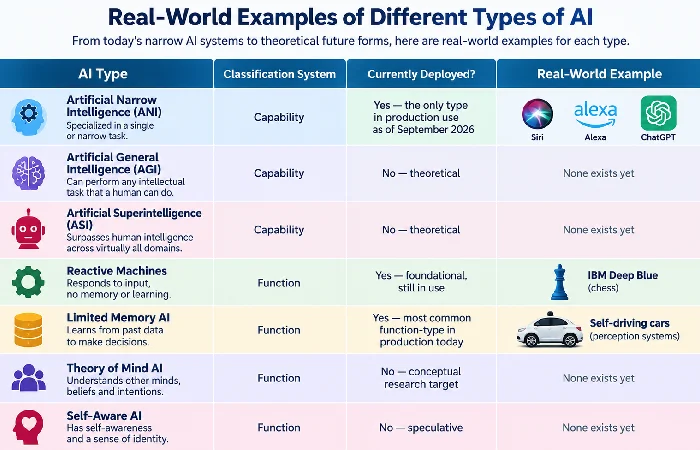
Putting both classification systems next to real products makes the abstractions concrete:
- Siri / Alexa: ANI, functionally Limited Memory (uses recent context and stored preferences)
- IBM Deep Blue: ANI, functionally Reactive (no memory across games)
- Self-driving car perception stacks: ANI, functionally Limited Memory (tracks recent sensor history)
- ChatGPT and comparable LLMs: ANI, despite broad task range, because training-distribution limits and lack of persistent cross-session memory keep it short of AGI
- AGI, ASI, Theory of Mind AI, Self-Aware AI: no implementations in deployment as of Sept ’26, these are just planning and research classifications, not shipping products.
First, if your team is bringing AI solutions into a specific workflow, you have to figure out whether it’s actually a Reactive or Limited Memory type, because that’s the real ceiling of that product, no matter what the label on the product page says.
Frequently Asked Questions
1. What are the 4 types of AI?
The four kinds of functioning AI are Reactive Machines, Limited Memory AI, Theory of Mind AI, and Self-Aware AI. Only the first two have been put into actual use, the other two are still theoretical.
2. Is ChatGPT narrow or general AI?
Narrow AI. It performs text-based tasks within a fixed training distribution and lacks persistent cross-session memory or cross-domain reasoning, both requirements for General AI.
3. Does self-aware AI exist yet?
No. Self-Aware AI is a research category describing a system that could reflect on its own internal states. No current model has demonstrated this.
4. What’s the difference between AGI and ASI?
AGI describes a system matching human-level intelligence across tasks. ASI describes a system exceeding human intelligence across the board. Both remain theoretical as of September 2026.