Published: September 9, 2026
Last Updated: September 9, 2026
You’ve already experienced AI today – probably several times, often without realizing. It filtered your email, recommended your next playlist, or guided your GPS around congestion before you reached it. But try to get anyone to give a proper definition of AI, and invariably it comes down to sci-fi references, or a shrug. That’s the gap this guide is trying to close. No robot metaphors here, just a plain look at what AI actually is, how the pieces fit, and roughly how long it takes before it starts making sense.
Quick Answer: AI lets computers learn from data and make their own calls, no step-by-step instructions needed. This guide gets into what AI actually is, how people split it into categories, generative AI vs machine learning vs deep learning, all of it.
Definition: AI for beginners really just means one thing, it’s not a machine that thinks or understands the world the way you do. It’s software. Trained on data. Picking up patterns, using them to predict what comes next.
What is artificial intelligence and how does it work?
Artificial Intelligence: Programs that learn patterns from data and do not follow instructions explicitly written down. Instead of directly instructing the system what to do by hard coding all instructions, engineers provide enormous amounts of text, images, numbers, etc to the system and the system then learns patterns about the data acquired, applying them to new situations it hasn’t seen before.
Here’s the basic pipeline behind almost every AI system in use today:
- Data collection — the system is given large volumes of examples (photos, sentences, transactions).
- Training — an algorithm adjusts internal parameters so its predictions match the examples as closely as possible.
- Inference — once trained, the system applies what it learned to brand-new input, like a photo it’s never seen.
- Feedback — real-world use generates new data that can retrain and improve the system over time.
According to IBM Developer, this pattern recognition is the dividing line between modern AI and the old “rule-based” software, which could never do anything more than follow directives and commands that humans provided in advance.
Worth getting this right: existing AI systems do not “understand” in the human sense. A model that produces a plausible paragraph about bereavement has learned the statistical shape of how humans speak about bereavement, it hasn’t experienced bereavement itself. That makes all the difference for how much trust we can put in AI output, a theme that recurs in this Guide.
Neural networks learn by adjusting internal weights over and over again until the network produces a desired output close enough.
What are the different types of artificial intelligence?
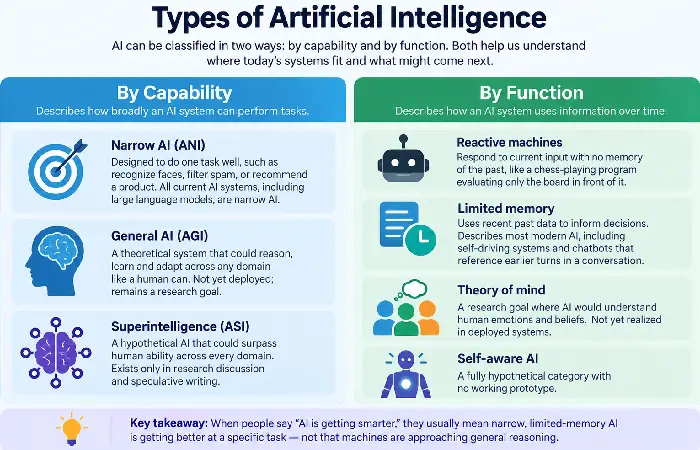
AI is ordered in two totally different typologies, and one of the most common newbie confusions is confusing them. One typology separates AI by capability; one separates it by function.
By capability:
- Narrow AI (ANI) — designed to do one task well: recognize faces, filter spam, recommend a product. Every AI product on the market in 2026 — including large language models — falls into this category.
- General AI (AGI) — a theoretical system that could reason, learn, and adapt across any domain the way a human can. No AGI system has been deployed; it remains a research goal, not a current product.
- Superintelligence (ASI) — a hypothetical AI surpassing human ability across every domain. This exists only in research discussion and speculative writing, not in any released system.
By function:
- Reactive machines — respond to current input with no memory of the past, like a chess-playing program evaluating only the board in front of it.
- Limited memory — uses recent past data to inform decisions, which describes most modern AI, including self-driving perception systems and chatbots that reference earlier turns in a conversation.
- Theory of mind — a research goal where AI would understand human emotions and beliefs; not yet realized in deployed systems.
- Self-aware AI — a fully hypothetical category with no working prototype.
The practical takeaway: when someone says “AI is getting smarter,” they almost always mean narrow, limited-memory AI is getting better at a specific task — not that machines are approaching general reasoning. For the full breakdown with examples of each category.
Generative AI, machine learning, and deep learning explained
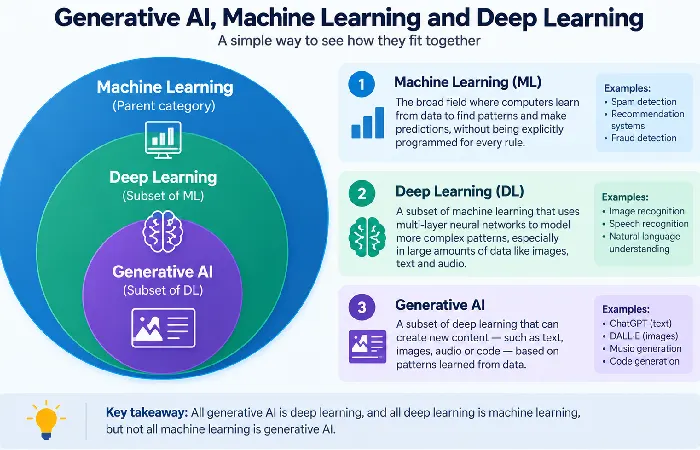
However, it is worth pointing out that each of these three terms gets used interchangeably, when they actually describe different, nested concepts, not synonyms:
- Machine learning (ML) is the large umbrella term covering any instance where software is being trained to detect patterns within data and predict something, without someone having to write out each specific rule. It’s the parent category.
- Deep learning is a branch of machine learning based on multi-layer neural networks (loosely inspired by neurons how they connect up in a brain), and capable of modeling more complex relationships than more basic ML algorithms. The required computing power and data sets were inaccessibly massive until the advent of relatively cheap cloud computing and the acceleration of GPGPU chips:
- Generative AI, another category often nested within AI, is defined as a subset of AI which (most often, certainly not always) builds the content it produces on deep learning so that it generates new content (text, images, audio, code rather than just classifying or predicting a single label). The phenomenon of Generative AI received much more mainstream attention after the general release of OpenAI’s ChatGPT in November 2022, the clearest event-dated marker for its recent becoming a part of mainstream consciousness.
A simple way to keep the hierarchy straight:
- Machine learning (the broad field)
- → Deep learning (a technique within ML using neural networks)
- → Generative AI (a deep learning application that creates new content)
Large language models, LLMs for short are what’s actually running ChatGPT, Claude, and Gemini. They’re a branch of generative AI, trained on huge amounts of text to guess the next most likely word. That’s really it. But from that one trick they can answer questions, condense a document down, copy a writing style, whatever you ask.
For newbies trying to figure out where to get a handle on something first, machine learning is generally the foundational skill that most entry level AI positions actually look for on a daily basis.
Real-world examples and applications of artificial intelligence
Most people run into AI dozens of times a day without ever calling it that. Read through a few examples though and the abstract definition starts making sense fast.
Everyday AI you likely already use:
- Spam filters – using machine learning to identify spam messages on the basis of earlier spam.
- Streaming and shopping recommendations – Netflix, Amazon, and other services use your previous viewing or purchasing choices to predict what you’ll want next.
- Voice assistants – Siri, Alexa, and Google Assistant use natural language processing to interpret spoken requests.
- Navigation apps – Google Maps and Waze use AI to predict how traffic flows and suggest routes in real time.
- Photo organization – phones automatically group photos by face or location using image-recognition models.
- Autocomplete and grammar suggestions: For example, Gmail’s Smart Compose anticipates what your next word might be while you’re writing.
By industry:
- Healthcare AI helps interpret scans and identifies irregularities for Radiologists to analyze.
- Finance: banks use AI to monitor transactions and identify suspicious activity to be investigated for fraud.
- Retail: advanced inventory systems use AI to forecast demand and reduce stockouts.
- Customer service: chatbots are used to answer common support questions before escalating the issue to a human agent.
Worth clarifying that AI is not exactly automation, as automation can be run on fixed rules without any learning (such as a thermostat), but AI refers specifically to an output that changes based on learned patterns in data. Not every “intelligent” feature is AI, and not every “AI-enabled” business process is actually running machine learning under the hood, a useful skepticism to carry into any vendor pitch.
For a deeper industry-by-industry breakdown, see the standalone guide on [real-world applications of AI by industry] (cluster page in progress).
What are the benefits and limitations of artificial intelligence?
AI’s value comes from doing narrow, well-defined tasks faster and more consistently than manual review — not from general judgment.
Benefits:
- Speed at scale — AI can review millions of transactions or images in the time a human reviews a handful.
- Pattern detection humans miss — subtle statistical patterns across huge datasets are often invisible to manual review but detectable by a trained model.
- Availability — AI-powered support tools don’t need sleep or shift schedules.
- Personalization — recommendation and content systems can tailor results at an individual level, which isn’t practical to do manually at scale.
Limitations, as of 2026:
- Hallucination – generative AI models sometimes “hallucinate” by confidently producing fluent, factually incorrect output particularly when asked about esoteric, niche, or fast-moving topics. This is not an outlier, a “special corner of the problem”; it is a current, unsolved research challenge.
- Bias – as models learn from the past, they will tend to learn biases that are in the data (e.g. bias in a hiring-screening process, lower performance of certain forms of facial recognition across some groups).
- Cost – extensive computing infrastructure is necessary to train and run large models, which is another reason why frontier AI tools are not free to use at scale, but do come with real subscription or usage costs.
- No real understanding – AI systems are pattern matchers; they don’t make inferences about causation or test hypotheses against ground truth the way a diligent human researcher would.
- Data dependency – an AI system is only as good as the data it was trained on; any holes or mistakes in the data become holes or mistakes in the output.
The practical consequence for a novice: assume that the AI response can be used as a rapid first draft which is to be double-checked, but should not be accepted as a finalized, reliable answer for most factual, medical, legal or financial queries.
How long does it take to learn AI, and where should a beginner start?
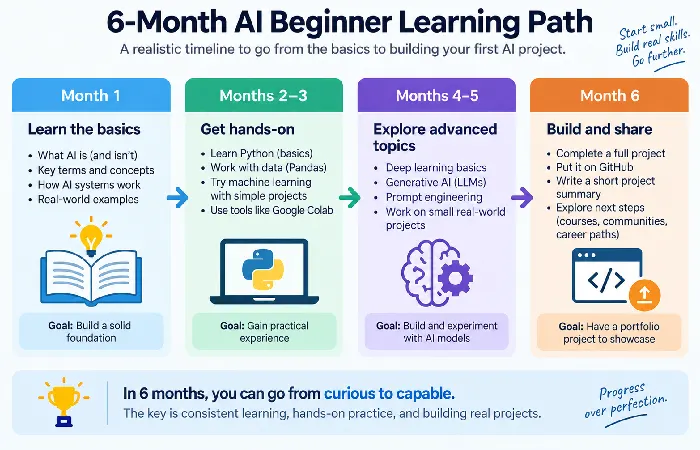
From a realistic starting benchmark, time commitments of 3–6 months of continuous part-time study should be enough to be comfortably conversant with AI ideas and confident in wielding AI tools on a regular basis (for example, in an office context) not to become a machine learning engineer. To achieve full, practically useful technical fluency (including doing some of your own model-building) you realistically need several times that.
A workable milestone breakdown:
- Weeks 1–4: Foundations. Learn the vocabulary in this guide — ML, deep learning, generative AI, narrow vs. general AI — and start using a mainstream AI chat tool daily for real tasks.
- Weeks 4–10: Structured course. Complete one free, named structured course rather than free-floating video watching. Goodwill Industries International points beginners toward Google’s free AI Essentials course as a concrete, no-cost entry point that builds practical, non-coding AI literacy.
- Weeks 10–16: Applied practice. Apply AI tools to a real project at work or in a personal project — drafting, data summarization, research — to move from theory to habit.
- 4-6 months, and thereafter: Choose whether to continue down a more technical track (Python, ML basics) or continue on the applied, non-technical track based on your career aspirations.
From a career perspective, Simplilearn indicates that the average machine learning engineer salary in the U.S. is about $162K, giving folks a concrete data point when weighing whether to pursue AI skills professionally rather than just as a personal productivity tool.
(Note that this reporting is on specialized ML engineering roles, not broad-based “AI literacy” roles, and you should view it as a ceiling.)
Frequently Asked Questions
1. Can beginners learn AI without coding?
Yes. All you need to do is to know how to use AI tools well and to understand how they work to apply them to real world problem. There is no need to code in any scenario. You need to code only if you want to build or tune models of your own.
2. What free tools should a total beginner actually start with?
Start with one mainstream generative AI chat tool (such as ChatGPT, Claude, or Gemini) for daily practice, plus Google’s free AI Essentials course, cited above, for structured foundational concepts. Avoid trying to learn from five tools simultaneously — depth with one tool builds faster intuition than breadth across many.
3. Is AI the same as automation?
No. Automation follows fixed, pre-written rules with no learning involved. AI specifically learns and adapts its output from data patterns, which is the core distinction that covered in the “What is AI” section above.
4. What are the current limitations of AI in 2026?
The main ones are hallucination (confident but wrong output), inherited bias from training data, real infrastructure cost, and a lack of true causal understanding — all detailed in the benefits and limitations section above.
Where to go from here
You now have the terms and the structure to understand the AI headlines, tool marketing pitches, and workplace chats without caught up in the hype or jargon.. The natural next step will be to compare some tools designed for non-technical users.