Published: September 7, 2026
Last Updated: September 7, 2026
Industrial automation takes over the plant operation so a human doesn’t have to touch every switch. It runs on control systems – PLCs, SCADA, DCS, and now increasingly IIoT sensors – which operate the equipment, track output and catch failures before they stop production. The market behind this shift is big and it’s not slowing down: the worldwide industrial automation and control systems market was worth USD 226.8 billion in 2025, headed to USD 250.3 billion in 2026, and expected to hit USD 504.4 billion by 2033, a CAGR of 10.5%. A thorough introduction to what the systems are, which category applies to each factory, the technologies involved, and the genuine economic and security trade-offs, with specific citations for every figure, not just stand-in adjectives.
Quick Answer: Production is run mostly by PLCs, SCADA, DCS, and IIoT sensors with little human intervention while capital equipment maintenance is aided by the initial investment of building a predictive maintenance program and can pay for itself up to 10X over. The Industrial Automation market is estimated to be between 226 and 250 billion dollars in 2026 depending on the research institution.
Definition: Industrial automation is the use of control systems, PLCs, SCADA, DCS, and robotics, to operate production equipment with minimal human input.
Market Size & Segment Snapshot
| Metric |
Standalone fact |
Source |
| Market size (2026, conservative) |
Industrial automation market grows from $210.68 billion in 2025 to $226.25 billion in 2026 at a 7.4% CAGR |
The Business Research Company |
| Market size (2026, higher estimate) |
Global market valued at $226.8 billion in 2025, projected to $250.3 billion in 2026, reaching $504.4 billion by 2033 at 10.5% CAGR |
Grand View Research |
| Regional leader |
Asia Pacific dominated with a 38% revenue share in 2025 |
Grand View Research |
| Segment leader |
Industrial control systems captured 45.30% of 2025 revenue |
Mordor Intelligence |
| Fastest-growing segment |
Robotics is the fastest-growing solution segment at 11.8% CAGR through 2031 |
Mordor Intelligence |
Figures are based on 2025–2026 publicly available information and other sources. Where there are two diverging estimates, both are presented as such rather than a “best” figure being identified.
What Is Industrial Automation and How Does It Work?
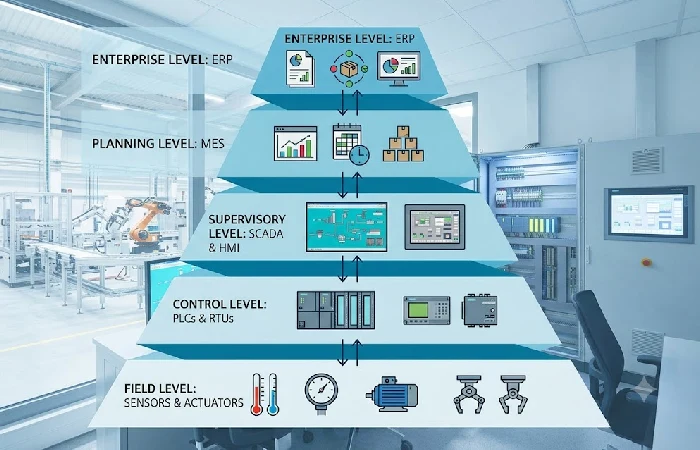
Automation is a stack (in the layered sense): sensors on the field level give information to controllers, supervisory software, planning systems and decision-makers until it reaches the company’s enterprise. Automation is a complex system: it replaces the punching of switches and writing logbooks with the chain of sensors, controllers and software that talk to each other. Not one machine works independently but the automation is a stack, each layer handing processed information up to the layer above it.
Perhaps the most obvious diagram of what this stack is based upon, is the Automation Pyramid. This is a five-tiered diagram that all industrial engineering would be familiar with, from the field level (sensors/actuators), up through PLCs, to SCADA and HMI, down to a planning tier, MES, and finally the enterprise ERP level. Electrical4U succinctly describes the ultimate aim of this automation stack: an integrated, flexible, cost effective automation platform for sensing, control, supervision and monitoring in a plant.
Where terminology can be ambiguous for readers: industrial automation is not equivalent to Industry 4.0. Automation is the physical and control layer – PLCs, sensors, actuators. Industry 4.0 sits on top of that, it’s the data-and-connectivity side: IIoT, digital twins, cloud analytics. Each can exist without the other, but a lot of modern factories are moving toward combining both.
How does the Automation Pyramid structure a factory?
The Automation Pyramid organizes a plant into five distinct levels, each with a specific job:
- Field level: sensors and actuators collecting raw physical data (temperature, pressure, position)
- Control level: PLCs executing real-time logic based on that data
- Supervisory level: SCADA and HMI systems giving operators visibility and manual override
- Planning level: Manufacturing Execution Systems (MES) scheduling production runs
- Enterprise level: ERP systems connecting production data to business decisions
Each level only talks to the one directly above or below it in a traditional architecture — a structural point most competitor guides skip entirely, despite it being the clearest mental model for understanding why a factory needs multiple systems rather than one master controller.
What is the difference between industrial automation and Industry 4.0?
Industrial automation is the hardware control layer – PLCs, sensors, actuators, robots that perform the repetitive measures without direct human oversight. Industry 4.0 is the digital layer that sits on top of that automation: the industrial IoT connectivity, the cloud analytics, the digital twins, AI-centered decision-making.
A factory can run purely automated PLC-managed production lines without any industry 4.0 connectivity – that was standard practice for decades. Industry 4.0 adds the ability for that same automated equipment to report data upward in real time, predict failures before they happen, and let enterprise software adjust production remotely. The distinction matters for IT automation comparisons too: IT automation orchestrates software workflows and infrastructure, while industrial automation controls physical machinery — a related but structurally separate discipline.
Types of Industrial Automation Systems
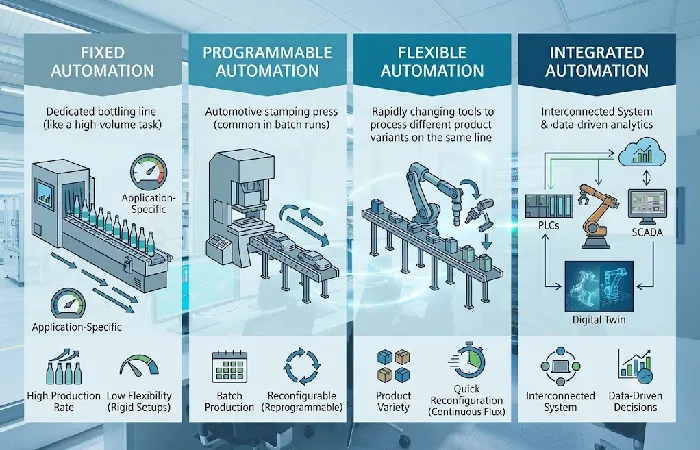
There are a total of four acknowledged types of industrial automation and are distinguished by how quickly the system can be adapted to a new product or a process change. What type you will use depends on your production rates, how often you change over product lines and how often you need to make adjustments to the line in a day. Clarify.io frames fixed automation specifically as a rigid, application-specific setup designed for permanent, high-volume tasks.
- Fixed (hard) automation: Built for one specific task at high volume — think a dedicated bottling line. Changeover to a new product requires physically rebuilding the line.
- Programmable automation: Reprogrammed in batches — common in automotive stamping presses where the whole line is reconfigured between model runs, not between individual units.
- Flexible automation: One reconfigures quickly with little or no downtime. This is where product variants are cycled through on the same line.
- Integrated automation: Combines PLCs, robotics and enterprise software as an integrated system, in which the data about production, quality control and inventories can be transferred automatically.
Fixed automation
Fixed automation applies where a factory makes one product, at high volume, indefinitely. It is the cheapest per-unit cost at scale because there’s no reprogramming overhead, but it’s also the least adaptable — retooling for a new product typically means replacing hardware, not just updating software. Bottling plants, engine block machining lines, and continuous-flow chemical processing are classic fixed-automation environments. The trade-off is stark: high efficiency for a single product, near-zero flexibility for anything else. This is why fixed automation shows up almost exclusively in industries with long product lifecycles — beverage, cement, and basic metals — rather than in industries with frequent model changes.
Programmable and flexible automation
Programmable automation reconfigures in batches; flexible automation reconfigures continuously. The difference is changeover speed. A programmable system — like an automotive stamping press — might take hours to reprogram between vehicle model runs, but then runs that single configuration for a full production batch. A flexible system, by contrast, can switch between product variants within minutes or even seconds, often mid-shift, without stopping the line. Flexible automation typically costs more per unit installed because it requires more sophisticated control software and often collaborative robotics, but it pays off in industries — electronics assembly, appliance manufacturing — where product variants change frequently and holding separate dedicated lines for each variant isn’t economical.
Integrated automation
Integrated automation is what connects the shop floor to the front office: rather than a PLC running a line in isolation, an integrated system links controllers, robotics and quality-inspection sensors to enterprise-resource planning software, so a change to customer orders dynamically affects production schedules. In this layer the Automation Pyramid planning and enterprise levels are beginning to actively cascade back down into the control level, rather than just flowing data up. Segment data shows where growth trends are heading: industrial control systems attracted 45.30% of 2025 revenue, and the fastest-growing solution through 2031 will be robotics, with 11.8% CAGR – a sign that integrated, robotics-heavy architectures are gaining share fastest.
Core Technologies Used in Industrial Automation
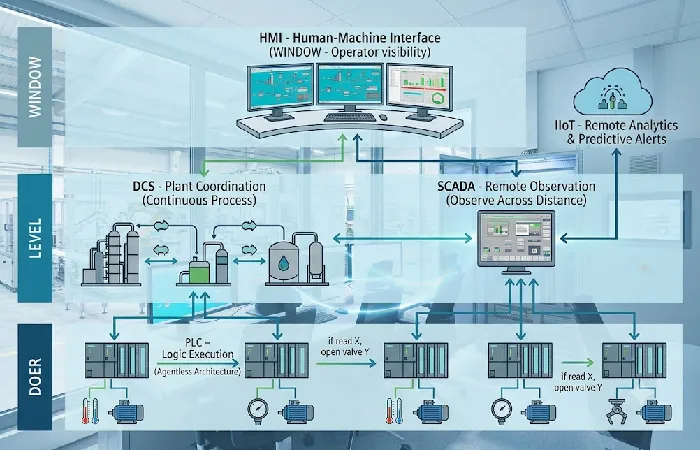
Four technologies are responsible for the bulk of what goes on inside an automated plant today: PLCs (logic execution), SCADA and DCS (supervision and coordination), HMI (operator visibility), and IIoT (sensors extending that visibility to the cloud). Each has a unique task, and getting them confused is one of the most prevalent issues when talking to vendors.
- PLC stands for Programmable Logic Controller, and it’s what implements the control logic in real time, right there on the factory floor.
- SCADA (Supervisory Control and Data Acquisition) works a level up from that – it pulls data in from many PLCs into one centralized spot so somebody can actually monitor it (pipelines are a common example).
- Then there’s DCS, or Distributed Control System, which handles a large number of control loops within a single plant. You’ll usually see this in continuous-process settings like refineries.
- HMI is the Human-Machine Interface – basically the display or dashboard an operator looks at to monitor and control everything.
- Last one, IIoT sensors: these extend monitoring out to the cloud, so you get remote analytics and predictive alerts without someone standing at the panel.
PLC market concentration is notable at the vendor level: Allen-Bradley holds roughly a 60% share in North American discrete automation, per Automate America’s market-share analysis, and 62% of manufacturing facilities worldwide rely on PLC systems for real-time monitoring and automation, according to Market Growth Reports.
PLC, SCADA, DCS and HMI — what’s the difference?
The simplest way to separate these four terms is by scope and role, not by “which is newer” or “which is better” — they typically work together, not as competitors:
- PLC is the doer — it executes the logic (“if sensor reads X, open valve Y”).
- DCS is the coordinator for one continuous plant — it manages many PLC-style control loops within one facility, common in refineries and chemical plants.
- SCADA is the observer across distance — it pulls data from many PLCs or DCS units spread across a wide area, common in pipelines and utilities.
- HMI is the window — it’s the screen an operator actually looks at to see what SCADA or the PLC is doing.
One rarely employs one of these things in isolation; a standard continuous-process operation has a DCS for coordination, PLCs for execution and an HMI for the operator interface, all feeding into a broader SCADA layer in the case of a multi-site operation.
Sensors, actuators and industrial networking
Sensors gather information from the physical world; actuators take that information and act; and industrial networking reliably transports the information between the two. Whether measuring a furnace temperature, a pipeline pressure, or a parcel proximity on a conveyor, sensors all feed raw data into the control layer. Actuators – motors, valves, pneumatic cylinders – are the other half of the loop, receiving commands from the PLC and physically executing the change. Industrial Networking protocols Profinet, EtherCAT, Modbus dictate how quickly and reliably that sensor-to-actuator loop closes. A sluggish or unreliable network layer can undermine an otherwise well-designed control system; network protocol should be considered a core engineering decision, not an afterthought, in today’s plant design.
Benefits and Challenges of Industrial Automation
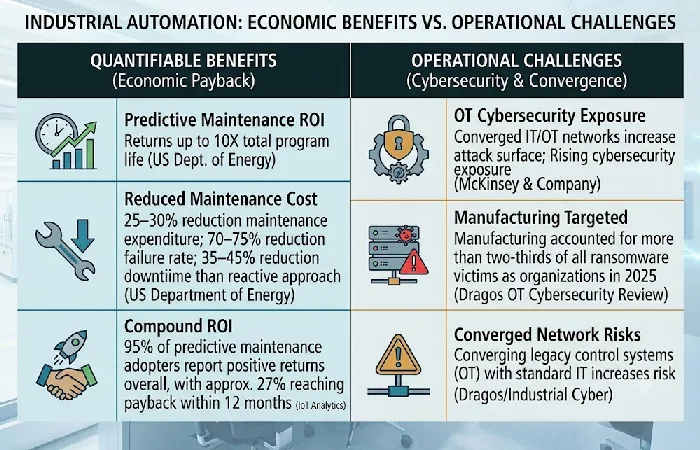
Industrial automation has quantifiable economic payback, but it also has a proven and increasing cybersecurity exposure, which most educational material glosses over. Each side of the ledger needs to be quantified, not generalized, for the trade-off to actually be useful to a decision-maker.
Financial benefits, quantified:
- A good predictive program will return as high as ten times, with 25–30% reduction in maintenance expenditure, 70–75% reduction of failure rate, and 35–45% reduction in downtime than reactive approach (US Department of Energy).
- McKinsey & Company has documented the maintenance cost reduction with predictive maintenance of 18–25% and unplanned downtime reduction of 30–50% over reactive techniques.
- Proactive repairs cost 4 to 5 times less than emergency repairs on the same asset, per McKinsey’s analysis.
- 95% of predictive maintenance adopters report positive returns overall, with approximately 27% reaching payback within 12 months, according to IoT Analytics.
Security and adoption challenges, quantified:
- High retrofit costs for brownfield plants and rising cybersecurity risks in converged IT/OT networks are the two most significant restraints on wider automation uptake, per Mordor Intelligence.
- 119 ransomware groups targeted industrial organizations in 2025, a 49% increase from the 80 tracked in 2024, and 3,300 industrial organizations were hit by ransomware compared with 1,693 in 2024, according to Dragos’s Annual OT Cybersecurity Year in Review.
- Manufacturing accounted for more than two-thirds of all ransomware victims across industrial organizations in 2025, per Dragos.
- 25% of ICS-CERT and NVD vulnerabilities had incorrect CVSS scores in 2025, and 26% of advisories contained no patch or mitigation from vendors, per Dragos’s findings reported via Industrial Cyber.
What ROI timeline should manufacturers expect?
Most predictive maintenance programs reach payback within 8 to 14 months, with roughly 27% of adopters hitting break-even inside 12 months, per IoT Analytics. The return compounds from there: the U.S. Department of Energy reports up to a 10x total return over the life of a well-run program, driven by 70–75% fewer breakdowns and 35–45% less downtime. That said, one vendor-affiliated source claimed a 90–95% downtime reduction figure — this guide excludes that number from its core data set because it comes from a monitoring-platform executive with a direct commercial interest in the claim, and it lacks independent verification. The DOE, McKinsey, and IoT Analytics figures used here come from parties without a product to sell.
What cybersecurity risks come with industrial automation?
Automation adoption and OT cybersecurity risk have risen together, not separately — connecting a control system to a network for monitoring also exposes it to ransomware. Dragos’s 2025 tracking shows industrial ransomware activity accelerating sharply, with manufacturing bearing more than two-thirds of the victim load. Alec Glenn, VP of Reliability at JSW Steel USA, put the operational trust issue plainly: when an operator can look at an AI platform and transparently audit its history — seeing the true positives, false positives, and the exact reasoning behind a recommendation — they trust the technology enough to act. This mandate of transparency applies to cybersecurity tooling just as directly as it does to predictive maintenance AI: unverifiable vendor assertions about “AI-powered threat detection” can be viewed just as skeptically as unverifiable uptime assertions.
Future Trends in Smart Manufacturing and Automation
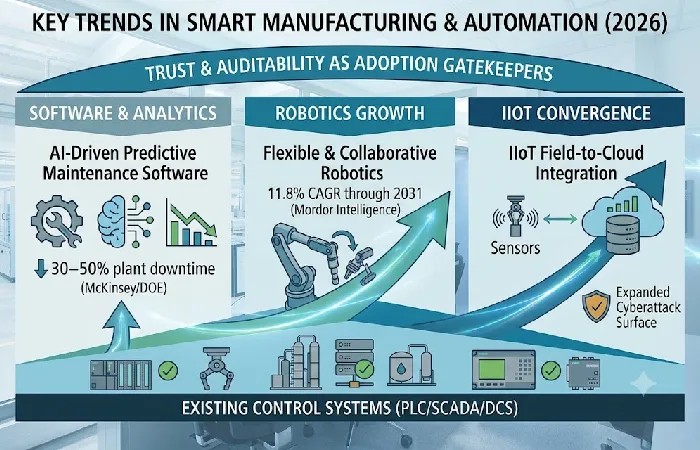
The clearest near-term trend is AI moving from a monitoring add-on to a core decision-making layer inside predictive maintenance, not a replacement for the underlying automation stack. Growth is concentrated in software and analytics layered on top of existing PLC/SCADA/DCS infrastructure, rather than in replacing that infrastructure outright.
- Predictive maintenance software continues compounding fastest among automation software categories, driven by the documented 18–50% downtime reductions covered above (McKinsey; DOE).
- Robotics remains the fastest-growing solution segment industry-wide at an 11.8% CAGR through 2031, per Mordor Intelligence — driven by integrated automation architectures needing flexible, reprogrammable execution rather than fixed hardware.
- IIoT convergence is expanding the field level of the Automation Pyramid outward to cloud analytics, but Mordor Intelligence flags the same convergence as a leading adoption barrier due to expanded cyberattack surface.
- Trust and auditability are emerging as adoption gatekeepers for AI-driven automation tools — a direct extension of the transparency standard Alec Glenn described for predictive maintenance platforms.
How is AI changing predictive maintenance?
AI is moving predictive maintenance away from scheduled inspection to realtime, sensor-driven prediction of failure before the fact. Instead of following a fixed schedule, AI models trained on vibration, temperature and vibration-pattern sensor data alert us to abnormalities in real time and make the 30–50% plant downtime reduction McKinsey observed possible. The limiting factor is not modeling, but operator trust in AI outputs that go unexplained. This is why auditability, as in Glenn’s criteria above, is becoming a purchasing criterion, rather than just a nice-to-have, for plant managers evaluating AI-driven maintenance platforms.
Frequently asked questions
1. How much does industrial automation cost to implement?
Cost of implementation will vary solely due to the type of automation used, fixed automation in a dedicated line per unit of output generally runs lower per-unit cost at scale but carries high upfront tooling costs, while flexible/integrated automation costs more per station due to programmable controllers and sensors but avoids full-line rebuilds for product changes. In most industries no gross “average cost” exists so when evaluating a plant’s automation cost, ask for a quote based on the scope of a particular line configuration. None of the ranking sources for this topic publish a verifiable blended figure.
2. Is industrial automation the same as robotics?
No — robotics is one execution technology within the broader automation category, not a synonym for it. There are examples of industrial automation that do not include any robotic arms, such as the use of PLCs, SCADA, sensors, and conveyor systems. A bottling line completely using fixed automation and conventional actuators is still industrial automation. Robotics is different – it refers to programmable arms or mobile robots doing physical work like welding, palletizing, or pick-and-place operations. Mordor Intelligence puts robotics at an 11.8% CAGR through 2031, making it the fastest-growing slice of the automation market. But it’s still just one part of a much broader category.
3. What jobs does industrial automation replace or create?
Industrial automation typically eliminates repetitive manual-execution roles (manual assembly, manual material handling) while creating demand for control-systems technicians, PLC programmers, and OT cybersecurity specialists. The shift documented by Dragos toward higher ransomware activity against manufacturing has itself created new demand for OT-specific security roles that didn’t exist at scale a decade ago — a direct, quantifiable job-creation effect of automation’s cybersecurity exposure rather than a general assumption.
4. What is the ROI timeline for industrial automation?
For predictive maintenance specifically, the majority of programs reach payback within 8 to 14 months, and roughly 27% hit break-even within 12 months, per IoT Analytics, with total returns compounding toward the U.S. Department of Energy’s documented up-to-10x figure over the program’s life. Broader automation ROI (beyond maintenance specifically) varies by automation type and cannot be generalized to a single timeline — fixed automation on high-volume lines typically pays back faster than flexible automation on low-volume, high-mix lines, due to the difference in upfront tooling cost per unit produced.