Published: September 8, 2026
Last Updated: September 8, 2026
Programmable logic controllers replaced relay panels in factories starting in 1968, and they still form the base layer of most discrete manufacturing control today. This guide breaks down what PLC automation means, how the scan cycle actually executes, what hardware sits inside the controller, where the technology gets deployed, and how it differs from DCS and SCADA — with sourced numbers at every claim instead of vague marketing language.
Quick Answer: A PLC runs a continuous input-process-output cycle, typically completing one scan in under 20ms, to control machines without manual switching.
Definition: “PLC automation is the use of programmable logic controllers to execute repeated input-process-output scan cycles — typically 0.5 to 100 milliseconds — that run machinery without continuous human input.”
Comparison snapshot: PLC vs. DCS at a glance
| System |
Typical cycle speed |
I/O capacity |
Best-fit use case |
Source |
| PLC (discrete control) |
4The scan time offered by a PLC is around 10 milliseconds which is much less than DCS |
41Multiple chassis can be linked via EtherNet/IP with up to 32,000 I/O points per controller |
Fast, repeatable machine and packaging-line control |
Circuit Globe; Industrial Monitor Direct |
| DCS (distributed control) |
4DCS provides a scan time of 100 to 500 milliseconds |
Scales across thousands of distributed loops |
Continuous process industries (refining, chemical) |
Circuit Globe |
| Programming standard |
17IEC 61131-3 establishes five programming languages and a common software model that enables code portability across different PLC manufacturers’ hardware |
N/A |
Vendor-neutral code reuse across Siemens, Allen-Bradley, and others |
IEC 61131-3 / PLCopen |
Methodology: Figures based on publicly available information and third-party sources.
What is PLC automation?
PLC automation is the practice of using a programmable logic controller to run a machine’s control logic automatically, replacing the electromechanical relay panels that preceded it. The controller reads sensor signals, applies stored logic, and drives outputs — motors, valves, indicator lights — on a fixed repeating cycle.
The technology traces back to a specific engineering problem, not an abstract concept. Bedford had a prototype up and running by March 1968, after Dick Morley composed a 12-page concept memo outlining the device on New Year’s Day. Morley led the development team at Bedford Associates that built the Modicon 084, and Bedford’s device met all the criteria for GM’s Standard Machine Controller spec, showing a 60% reduction in downtime versus relay-controlled equipment during factory testing.
Dick Morley became known as the ‘father of the programmable logic controller’ for leading the team at Bedford Associates in 1968 that developed the world’s first PLC the Modicon 084.
Today, then, PLC automation has become part of a larger industrial automation structure where a whole range of sensors, drive tools and supervisory software are layered on top of the controller itself.
How do PLC systems work?
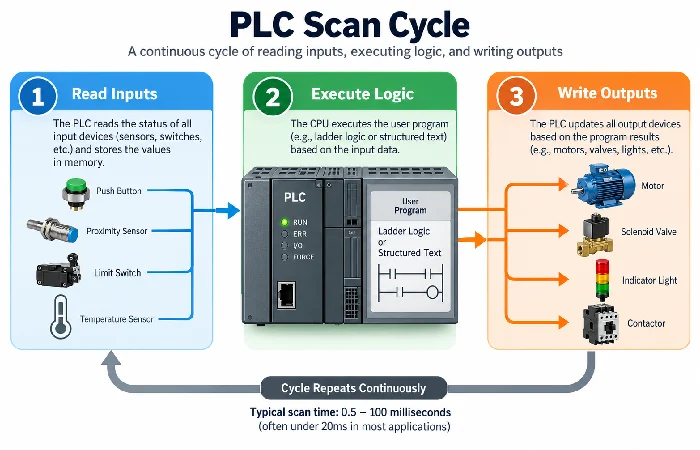
The PLC is constantly running through a three-step scan cycle: read inputs, run logic, and write outputs. It repeats this cycle often dozens of times a second. The three essential steps performed within every cycle are: first, it reads all input signals from field devices; second, the CPU executes the user program based on ladder logic or structured text; third, it updates all output devices.
Cycle speed depends directly on program size and processor load:
- Scan times vary quite a bit depending on program size. A short program might wrap up in 3–5 milliseconds. Get into longer, more complex routines and you’re looking at 60–70 milliseconds.
- Anything beyond that range and actuator response starts to drag. At that point you’re either looking at a faster processor or splitting the load across multiple CPUs.
- A full scan cycle can exceed 25 milliseconds when extra system requirements are added, such as diagnostics or communication servicing.
The consistent, repeatable scan time is the reason why PLC’s are still used today in industrial automation systems where deterministic control is more important than continuous analog processing.
What are the main components of a PLC?
The five essential hardware elements of all PLCs are a CPU, memory, power supply, input modules and output modules. A PLC has five principal elements: 1. CPU/Processor, 2. Memory system, 3. Power supply, 4. Input modules, 5. Output modules.
Each part has a distinct job:
- CPU: The CPU is the brain of the PLC. It pulls the control program from memory, scans inputs, and decides what the outputs should do. Scan cycle management, communication, and arithmetic operations all run through it.
- Memory: PLC memory runs in three layers. ROM holds the firmware and doesn’t change. RAM is the working memory while the program runs, usually battery-backed so it survives a power cut. EEPROM or Flash handles long-term program backup.
- Power supply: Incoming voltage isn’t usable by the PLC components directly. The power supply steps it down to the levels the CPU and modules actually need, typically 24VDC for field devices and 5VDC for internal logic.
- I/O modules — 20discrete I/O handles on/off signals from devices like pushbuttons and proximity sensors, while analog I/O processes continuous signals from devices like temperature transmitters and pressure sensors.
Where is PLC automation used in industry?
PLC automation controls discrete manufacturing processes – assembly lines, packaging cells, conveyor sorting, and machine sequencing – anywhere a fixed, repeatable logic sequence needs to run reliably. Since PLCs handle deterministic on/off and sequential logic well, they dominate factory-floor control rather than continuous process control.
Scale varies enormously by platform. On the high end, Allen-Bradley ControlLogix controllers link multiple chassis via EtherNet/IP with up to 32,000 I/O points per controller, while ControlLogix processors range from the entry-level L71 with 2 MB of memory to the high-performance L85 with 40 MB and support for over 100,000 I/O points. This range lets the same programming platform – which supports all IEC 61131-3 languages with tag-based addressing and no fixed memory map – scale from a single packaging machine to a plant-wide control network.
For readers scoping a specific deployment, capacity planning starts with counting I/O points per machine, not per plant, since most PLC-controlled equipment uses a small fraction of these maximums.
How does a PLC compare to other industrial control systems?
A PLC is a centralized, discrete-logic controller optimized for speed and reliability on a single machine or line; a DCS is a distributed system optimized for scale across many analog control loops; a SCADA is above these two systems as a supervisory monitoring layer. The core difference is architecture and response time, not raw capability.
- Scan/response speed: 4The scan time offered by a PLC is around 10 milliseconds, which is much less than a DCS, which provides a scan time of 100 to 500 milliseconds.
- Control philosophy: 4A PLC is a central controller designed to control processes or machines, while a DCS is a distributed system with no central controller but various dispersed controllers offering control to the complete system.
- Origin: PLC replaced electromechanical relays and a DCS replaced single-loop controllers by including multiple control components.
Standardisation of programming languages reduces the platform difference: there are still many users of ladder logic because of its graphical and visual approach; instruction list, flow chart and structured text are all standardized by the IEC 61131-3 standard.
Frequently asked questions
1. Is a PLC a computer?
Yes. A PLC an industrial computer adapted for the control of manufacturing processes such as assembly lines, robotic devices, or any activity that requires high reliability control, ease of programming, and fault diagnostics. It runs a stored program like any computer, but its hardware and operating cycle are purpose-built for repetitive, real-time machine control rather than general computing.
2. What is the difference between PLC and SCADA?
Programmable Logic Controller controls the logic within each machine. SCADA is a supervisory software layer over the PLCs within a site or region, visualizing information from several of them. In most cases SCADA doesn’t replace the scan-cycle logic of the PLCs, it just displays what they are doing, and also handles historian and alarm-management functions.
3. What programming languages do PLCs use?
The IEC 61131-3 standard has five PLC programming languages – Ladder Diagram, Function Block Diagram, Structured Text, Instruction List, and Sequential Function Chart. Ladder Diagram is the one everybody actually uses though, more than 80% of PLC programming worldwide runs on it. Mainly because it looks similar to the relay circuits it replaced, so it was an easy switch for people already used to reading relay logic.
4. Who invented the PLC?
Dick Morley best known as the “father of the programmable logic controller” led the development of the world’s first PLC, the Modicon 084, in 1968 while at Bedford Associates. General Motors ended up ordering one million dollars’ worth of PLCs from Modicon and took delivery of its first batch in November 1969.
Start by mapping your own line’s I/O count against the ControlLogix and CompactLogix capacity tiers above before selecting a controller family — undersizing I/O capacity most common reason and PLC upgrades repeated within two years of commissioning.